TABLE OF CONTENTS
Page
1.4 Summary of Construction Works
1.5 Summary of EM&A Programme Requirements
2.4 Monitoring Parameters, Frequency and Duration
2.6 Monitoring Schedule for the Reporting Month
3.4 Monitoring Parameters, Frequency and Duration
3.6 Monitoring Schedule for the Reporting Month
4.3 Monitoring Parameters, Frequency and Duration
4.6 Monitoring Schedule for the Reporting Month
5.3 Monitoring Frequency and Conditions
5.4 Monitoring Methodology and Location
5.6 Monitoring Schedule for the Reporting Month
6. ENVIRONMENTAL SITE INSPECTION AND AUDIT
6.2 Advice on the Solid and Liquid Waste Management Status
6.3 Environmental Licenses and Permits
6.4 Implementation Status of Environmental Mitigation Measures
6.5 Summary of Exceedances of the Environmental Quality Performance Limit
6.6 Summary of Complaints, Notification of Summons and Successful Prosecutions
7.1 Construction Programme for the Coming Months
7.2 Key Issues for the Coming Month
7.3 Monitoring Schedule for the Coming Month
8. ConclusionS AND RECOMMENDATIONS
List of Tables
Table 1.1 Contact Information of Key Personnel
Table 2.1 Air Quality Monitoring Equipment
Table 2.2 Locations of Impact Air Quality Monitoring Stations
Table 2.3 Air Quality Monitoring Parameters, Frequency and Duration
Table 2.4 Summary of 1-hour TSP Monitoring Results in the Reporting Period
Table 2.5 Summary of 24-hour TSP Monitoring Results in the Reporting Period
Table 3.1 Noise Monitoring Equipment
Table 3.2 Locations of Impact Noise Monitoring Stations
Table 3.3 Noise Monitoring Parameters, Frequency and Duration
Table 3.4 Summary of Construction Noise Monitoring Results in the Reporting Period
Table 4.1 Water Quality Monitoring Equipment
Table 4.2 Impact Water Quality Monitoring Parameters and Frequency
Table 4.3 Impact Water Quality Monitoring Stations
Table 4.4 Laboratory Analysis for Suspended Solids
Table 4.5 Summary of Water Quality Exceedances
Table 5.1 Dolphin Monitoring Equipment
Table 5.2 Impact Dolphin Monitoring Line Transect Co-ordinates (Provided by AFCD)
Table 5.3 Impact Dolphin Monitoring Survey Effort Summary, Effort by Area and Beaufort Sea State
Table 5.4 Impact Dolphin Monitoring Survey Details October 2014
Table 5.5 The Encounter Rate of Number of Dolphin Sightings & Total Number of Dolphins per Area^
Table 6.1 Summary of Environmental Licensing and Permit Status
Figures
Figure 1 General Project Layout Plan
Figure 2 Impact Air Quality and Noise Monitoring Stations and Wind Station
Figure 3 Impact Water Quality Monitoring Stations
Figure 4 Impact Dolphin Monitoring Line Transect Layout Map
Figure 5 Impact Dolphin Monitoring Survey Efforts and Sightings in October 2014
Figure 6 Environmental Complaint Handling Procedures
List of Appendices
Appendix A Project Organization for Environmental Works
Appendix B Three Month Rolling Construction Programmes
Appendix C Implementation Schedule of Environmental Mitigation Measures (EMIS)
Appendix D Summary of Action and Limit Levels
Appendix E Calibration Certificates of Monitoring Equipments
Appendix F EM&A Monitoring Schedules
Appendix G Impact Air Quality Monitoring Results and their Graphical Presentation
Appendix H Meteorological Data for Monitoring Periods on Monitoring Dates in October 2014
Appendix I Impact Construction Noise Monitoring Results and their Graphical Presentation
Appendix J Impact Water Quality Monitoring Results and their Graphical Presentation
Appendix K Impact Dolphin Monitoring Survey Sighting Summary
Appendix M Monthly Summary of Waste Flow Table
EXECUTIVE SUMMARY
Contract No. HY/2010/02 – Hong Kong-Zhuhai-Macao
Bridge Hong Kong Boundary Crossing Facilities – Reclamation Work (here below,
known as “the Project”) mainly comprises reclamation at the northeast
of the Hong Kong International Airport
of an area of about 130-hectare for
the construction of an artificial island for the development of the Hong Kong
Boundary Crossing Facilities (HKBCF), and about 19-hectare for the southern
landfall of the Tuen Mun - Chek Lap Kok Link (TMCLKL). It is a designated
project and is governed by the current permits for the Project, i.e. the
amended Environmental Permits (EPs) issued on 06 August 2013 (EP-353/2009/G)
and 28 January 2014 (EP-354/2009/B) (for TMCLKL Southern Landfall Reclamation
only).
Ove Arup & Partners Hong Kong Limited (Arup) was
appointed by Highways Department (HyD) as the consultants for the design and
construction assignment for the Project’s reclamation works (i.e. the Engineer
for the Project).
China Harbour Engineering Company Limited (CHEC) was
awarded by HyD as the Contractor to undertake the construction work of the
Project.
ENVIRON Hong Kong Ltd. was employed by HyD as the
Independent Environmental Checker (IEC) and Environmental Project Office (ENPO)
for the Project.
AECOM Asia Co. Ltd. (AECOM) was appointed by CHEC to
undertake the role of Environmental Team for the Project for carrying out the
environmental monitoring and audit (EM&A) works.
The construction phase of the Project under the EPs
was commenced on 12 March 2012 and will be tentatively completed by early Year
2016. The EM&A programme, including air quality, noise, water quality and
dolphin monitoring and environmental site inspections, was commenced on 12
March 2012.
This report documents the findings of EM&A works conducted in the period between 1 and 31 October 2014. As informed by the Contractor, major activities in the reporting period were:-
Marine-base
- Capping Beams structures
- Optimizing rubble mound seawalls
- Conforming sloping seawalls
- Laying geo-textile
- Rock filling
- Sand filling
- Public filling
- Band drain installation
- Surcharge remove & laying
- Geotechnical Instrumentation works
- Precast Yard for seawall blocks & culverts
- Maintenance of silt curtain & silt screen at sea water intake of HKIA
Land-base
- Maintenance works of Site Office at Works Area WA2
- Maintenance works of Public Works Regional Laboratory at Works Area WA3
- Maintenance of Temporary Marine Access at Works Area WA2
A summary of monitoring and audit activities conducted in the reporting period is listed below:
|
24-hour Total Suspended Particulates (TSP) monitoring 1-hour TSP monitoring |
5 sessions 5 sessions |
|
Noise monitoring |
4 sessions |
|
Impact water quality monitoring |
14 sessions |
|
Impact dolphin monitoring |
2 surveys |
|
Joint Environmental site inspection |
5 sessions |
Breaches of Action and Limit Levels for Air Quality
One (1) 24-hour TSP result at AMS3B exceeded Action Level on 27 October 2014, after investigation, the exceedance was considered not related to this Contract. All 1-Hour TSP results were below the Action and Limit Level in the reporting month.
Breaches
of Action and Limit Levels for Noise
For construction noise, no
exceedance was recorded at all monitoring stations in the reporting period.
Breaches of Action and Limit Levels for Water Quality
A total of (18) eighteen exceedances were recorded in this reporting
month: (1) One Limit Level Exceedance of Turbidity and (1) Limit Level
Exceedance of Suspended Solids were recorded at IS17 during ebb tide on 10
October 2014; (1) One Action Level Exceedance of SS at SR10B(N) was recorded
on10 October 2014 during flood tide; (1) One Action Level Exceedance of SS at
IS8 was recorded on 3 October 2014 during flood tide; (1) One Action Level
Exceedance of SS at IS(Mf)11 was recorded on 6 October 2014 during ebb tide;
(2) Two Action Level Exceedances of SS at IS(Mf)11 and SR5 were recorded on 6
October 2014 during flood tide; (3) Three Action Level Exceedances of SS were
recorded at IS10, SR4(N) and SR5 on 13 October 2014 during flood tide; (1) One
Action Level Exceedance of SS was recorded at IS17 on 20 October 2014 during
ebb tide; (1) action level exceedance and (1) limit level exceedance of SS were
recorded at SR4(N) and IS8 respectively on 20 October 2014 during flood tide;
(2) Two Action Level Exceedances of SS were recorded at SR10A and SR10B(N) on
22 October 2014 during flood tide; (2) Two Action Level Exceedances of SS were
recorded at IS10 and SR4(N) during flood tide on 24 October 2014. (1) Action
Level Exceedance was recorded at IS8 on 31 October 2014 during ebb tide.
After investigation, all impact water quality exceedances were
considered not related to this Contract except the Limit Level Exceedance of
Turbidity, Limit Level Exceedance of Suspended Solids recorded at IS17 during
ebb tide on 10 October 2014 and Action Level Exceedance of Suspended Solids
recorded at IS17 during flood tide on 20 October 2014, which were considered
related to this Contract. Recommendation has been given and rectification has
been carried on by the Contractor on 28 October 2014.
Impact Dolphin Monitoring
A total of six sightings were made, four “on effort” and two
“opportunistic”. Three sightings were made on the 13 October 2014 in NWL
and three sightings were made on 20 October 2014 also in NWL. A total of
twenty-two individuals were sighted from the two impact dolphin surveys in the
reporting period. Sighting details are summarised and plotted in Appendix K and
Figure 5c, respectively.
Behaviour: Of the six sightings, two groups were feeding, one group was
travelling and three groups was engaged in multiple activities, two of which
comprised feeding and surface active behaviours and one of which comprised
feeding and travelling behaviours. The locations of sighting with different
behaviour are mapped in Figure 5d.
Two calves were recorded in October 2014. The mother of one was HZMB
026. The location of sighting with calf is mapped in Figure 5e.
Complaint, Notification of Summons and Successful Prosecution
Two environmental complaints have been received in
October 2014.
As informed by the Contractor
yesterday, 14 October 2014, a follow up air quality complaint has been received
by this Contract (same case to environmental complaint reported in the last
reporting month). The complainant complained that about 20-30 sand barges
always moor at the sea area opposite to tower 4 of Melody Garden and Richland Garden.
This problem has affected the air quality. After investigation,
there is no adequate information to conclude the observed impact is related to
this Contract.
With reference to RSS’s
letter ref.: 211036/(HY2010/02)/M05/432/B07605 dated on 30 September 2014
pertaining the performance on barges operations at the sea area off the Tuen
Mun Ferry Pier. A complaint concerning leakage of sand filling material from
vessels at sea area off Tuen Mun Ferry Pier was first received by EPD from Tuen
Mun District Council (TM DC) on 19 September 2014 and it was subsequently
referred by EPD to the Highways Department to handle on 23 September 2014
through EPD’s memo ref.: EP/RW/0000362128.Referring to EPD's Memo, it is also
noted that some local residents at Tuen Mun expressed their concern that the
stockpile of dusty sand material on the barges should be covered with
impervious sheeting to avoid causing fugitive dust emissions of sand and
dust. Subsequently, TM DC followed up their complaint with Highways Department
on 17 October 2014. The follow up complaint concerning water quality impact at
sea area off Tuen Mun area was referred to the project team to response on 17
October 2014. After investigation, there is no adequate information
to conclude the observed impact is related to this Contract.
No notification of summons or prosecution was received in the reporting period.
Reporting Change
There was no reporting change required in the reporting period.
Future Key Issues
Key issues to be considered in the coming month included:-
- Site runoff should be properly collected and treated prior to discharge;
- Minimize loss of sediment from filling works;
- Regular review and maintenance of silt curtain systems, drainage systems and desilting facilities;
- Exposed surfaces/soil stockpiles should be properly treated to avoid generation of silty surface run-off during rainstorm;
- Regular review and maintenance of wheel washing facilities provided at all site entrances/exits;
- Conduct regular inspection of various working machineries and vessels within works areas to avoid any dark smoke emission;
- Suppress dust generated from work processes with use of bagged cements, earth movements, excavation activities, exposed surfaces/soil stockpiles and haul road traffic;
- Quieter powered mechanical equipment should be used;
- Provision of proper and effective noise control measures for operating equipment and machinery on-site, such as erection of movable noise barriers or enclosure for noisy plants;
- Closely check and replace the sound insulation materials regularly;
- Better scheduling of construction works to minimize noise nuisance;
- Properly store and label oil drums and chemical containers placed on site;
- Proper chemicals, chemical wastes and wastes management;
- Maintenance works should be carried out within roofed, paved and confined areas;
- Collection and segregation of construction waste and general refuse on land and in the sea should be carried out properly and regularly; and
- Proper protection and regular inspection of existing trees, transplanted/retained trees.
- Control night-time lighting and glare by hooding all lights.
- Regular review and provide maintenance to dust control measures such as sprinkler system.
1
introduction
1.1
Background
1.1.1
Contract No. HY/2010/02 – Hong Kong-Zhuhai-Macao
Bridge Hong Kong Boundary Crossing Facilities – Reclamation Work (here below,
known as “the Project”) mainly comprises reclamation at the northeast
of the Hong Kong International Airport
of an area of about 130-hectare for
the construction of an artificial island for the development of the Hong Kong
Boundary Crossing Facilities (HKBCF), and about 19-hectare for the southern
landfall of the Tuen Mun - Chek Lap Kok Link (TMCLKL).
1.1.2
The environmental impact
assessment (EIA) reports (Hong Kong –
Zhuhai – Macao Bridge Hong Kong Boundary Crossing Facilities
– EIA Report (Register No. AEIAR-145/2009) (HKBCFEIA) and Tuen Mun – Chek Lap
Kok Link – EIA Report (Register No. AEIAR-146/2009) (TMCLKLEIA), and their
environmental monitoring and audit (EM&A) Manuals (original EM&A
Manuals), for the Project were approved by Environmental Protection Department
(EPD) in October 2009.
1.1.3
EPD subsequently issued the
Environmental Permit (EP) for HKBCF in November 2009 (EP-353/2009)
and the Variation of Environmental Permit (VEP) in June 2010
(EP-353/2009/A), November 2010 (EP-353/2009/B),
November 2011 (EP-353/2009/C), March 2012 (EP-353/2009/D), October
2012 (EP-353/2009/E), April 2013 (EP-353/2009/F) and August 2013
(EP-353/2009/G). Similarly, EPD issued the Environmental Permit (EP) for TMCLKL
in November 2009 (EP-354/2009) and the Variation of Environmental Permit (VEP)
in December 2010 (EP-354/2009/A) and January 2014 (EP-354/2009/B).
1.1.4
The Project is a designated project and is governed by
the current permits for the Project, i.e. the amended EPs issued on 6 August
2013 (EP-353/2009/G) and 28 January 2014 (EP-354/2009/B) (for TMCLKL Southern
Landfall Reclamation only).
1.1.5
A Project Specific EM&A Manual, which included all
project-relation contents from the original EM&A Manuals for the Project,
was issued in May 2012.
1.1.6
Ove Arup & Partners Hong Kong Limited (Arup) was
appointed by Highways Department (HyD) as the consultants for the design and
construction assignment for the Project’s reclamation works (i.e. the Engineer
for the Project).
1.1.7
China Harbour Engineering Company Limited (CHEC) was
awarded by HyD as the Contractor to undertake the construction work of the
Project.
1.1.8
ENVIRON Hong Kong Ltd. was employed by HyD as the
Independent Environmental Checker (IEC) and Environmental Project Office (ENPO)
for the Project.
1.1.9
AECOM Asia Co. Ltd. (AECOM) was appointed by CHEC to
undertake the role of Environmental Team for the Project for carrying out the
EM&A works.
1.1.10 The construction phase of the Project under the EPs was commenced on 12
March 2012 and will be tentatively completed by early Year 2016.
1.1.11 According to the Project Specific EM&A Manual, there is a need of an
EM&A programme including air quality, noise, water quality and dolphin
monitoring and environmental site inspections. The EM&A programme of the
Project commenced on 12 March 2012.
1.2
Scope of Report
1.2.1
This is the thirty-second monthly EM&A Report
under the Contract No.HY/2010/02 Hong Kong-Zhuhai-Macao Bridge Hong Kong
Boundary Crossing Facilities – Reclamation Works. This report presents a
summary of the environmental monitoring and audit works, list of activities and
mitigation measures proposed by the ET for the Project in October 2014.
1.3
Project
Organization
1.3.1 The project organization structure is shown in Appendix A. The key
personnel contact names and numbers are summarized in Table 1.1.
Table 1.1 Contact Information of Key Personnel
|
Party |
Position |
Name |
Telephone |
Fax |
|
Engineer’s Representative (ER) (Ove Arup & Partners Hong Kong Limited) |
Chief Resident Engineer |
Roger Marechal |
3698 5700 |
2698 5999 |
|
IEC / ENPO (ENVIRON Hong Kong Limited) |
Independent Environmental Checker |
Raymond Dai |
3465 2888 |
3465 2899 |
|
Environmental Project Office Leader |
Y. H. Hui |
3465 2868 |
3465 2899 |
|
|
Contractor
(China Harbour Engineering Company Limited) |
Environmental Officer |
Richard Ng |
36932253 |
2578 0413 |
|
24-hour Hotline |
Alan C.C. Yeung |
9448 0325 |
-- |
|
|
ET (AECOM Asia Company Limited) |
ET Leader |
Echo Leong |
3922 9280 |
2317 7609 |
1.4
Summary
of Construction Works
1.4.1
The construction phase of the Project under the EP
commenced on 12 March 2012.
1.4.2
As informed by the Contractor, details of the major
works carried out in this reporting period are listed below:-
Marine-based Works
- Cellular structure installation
- Optimizing rubble mound seawalls
- Conforming sloping seawalls
- Laying geo-textile
- Sand blanket laying
- Sand filling
- Rock filling
- Maintenance of silt curtain & silt screen at sea water intake of HKIA
- Band drain installation
- Backfill cellular structure
- Geotechnical Instrumentation works
- Surcharge laying
- Capping Beams structures
- Construction of temporary jetties for surcharge laying
- Temporary Watermain construction
- Flat barge of unloading public fill for surcharge laying
- Precast Yard Setup
Land-based Works
- Maintenance works of Site Office at Works Area WA2
- Maintenance works of Public Works Regional Laboratory at Works Area WA3
- Maintenance of Temporary Marine Access at Works Area WA2
1.4.3 The 3-month rolling construction programme of the Project is shown in
Appendix B.
1.4.4
The general layout plan of the Project site showing
the detailed works areas is shown in Figure 1.
1.4.5
The environmental mitigation measures implementation
schedule are presented in Appendix C.
1.5
Summary
of EM&A Programme Requirements
1.5.1
The EM&A programme required environmental
monitoring for air quality, noise, water quality, marine ecology and
environmental site inspections for air quality, noise, water quality, waste
management, marine ecology, and landscape and visual impact. The EM&A
requirements for each parameter described in the following sections include:-
- All monitoring parameters;
- Monitoring schedules for the reporting month and forthcoming month;
- Action and Limit levels for all environmental parameters;
- Event / Action Plan;
- Environmental mitigation measures, as recommended in the Project EIA reports; and
- Environmental requirement in contract documents.
2
AIR QUALITY
MONITORING
2.1
Monitoring
Requirements
2.1.1
In accordance with the Project Specific EM&A Manual,
baseline 1-hour and 24-hour Total Suspended Particulates (TSP) levels at 4 air
quality monitoring stations were established. Impact 1-hour TSP monitoring was
conducted for at least three times every 6 days, while impact 24-hour TSP
monitoring was carried out for at least once every 6 days. The Action and Limit
level of the air quality monitoring is provided in Appendix D.
2.2
Monitoring
Equipment
2.2.1
24-hour TSP air quality monitoring was performed using
High Volume Sampler (HVS) located at each designated monitoring station. The
HVS meets all the requirements of the Project Specific EM&A Manual.
Portable direct reading dust meters were used to carry out the 1-hour TSP
monitoring. Brand and model of the equipment is given in Table 2.1.
Table 2.1 Air Quality Monitoring Equipment
|
Equipment |
Brand and Model |
|
Portable direct reading dust meter (1-hour TSP) |
Sibata Digital Dust Monitor (Model No. LD-3 and LD-3B) |
|
High Volume Sampler |
Tisch Environmental Mass Flow Controlled Total Suspended Particulate (TSP) High Volume Air Sampler (Model No. TE-5170) |
2.3
Monitoring Locations
2.3.1
Monitoring locations AMS2 and AMS7 were set up at the
proposed locations in accordance with Project Specific EM&A Manual. For
AMS6 (Dragonair/CNAC (Group) Building), permission on setting up and carrying
out impact monitoring works was sought, however, access to the premise has not
been granted yet on this report issuing date. For monitoring location AMS3 (Ho
Yu College), as proposed in the Project Specific EM&A Manual, approval for
carrying out impact monitoring could not be obtained from the principal of the
school. Permission on setting up and carrying out impact monitoring works at
nearby sensitive receivers, like Caribbean Coast and Coastal Skyline, was also
sought. However, approvals for carrying out impact monitoring works
within their premises were not obtained. Impact air quality monitoring was
conducted at site boundary of the site office area in Works Area WA2 (AMS3B)
respectively. Same baseline and Action Level for air quality, as derived from
the baseline monitoring data recorded at Ho Yu College, was adopted for this
alternative air quality location.
2.3.2
It was observed that a tree near AMS3B may affect the
wind flow around the HVS located at AMS3B. With no further comment received
from IEC, the HVS at AMS3B has been relocated on 8 September 2014 to slightly
more than 2 meters separation from it, measured horizontally. Same baseline
and Action Level for air quality, as derived from the baseline monitoring data
recorded at Ho Yu College, was adopted for this alternative air quality
location.
2.3.3
Reference is made to ET’s proposal of the omission of
air monitoring station (AMS 6) dated on 1 November 2012 and EPD’s
letter dated on 19 November 2012 regarding the conditional approval of the
proposed omission of air monitoring station (AMS 6) for Contract No.
HY/2010/02. The aforesaid omission of Monitoring Station AMS6 is effective
since 19 November 2012.
2.3.4
Figure 2 shows the locations of monitoring stations.
Table 2.2 describes the details of the monitoring stations.
Table 2.2 Locations of Impact Air Quality Monitoring Stations
|
Monitoring Station |
Location |
Description |
|
AMS2 |
Tung Chung Development Pier |
Rooftop of the premise |
|
AMS3B |
Site Boundary of Site Office Area at Works Area WA2 |
On ground at the area boundary |
|
AMS6* |
Dragonair/CNAC (Group) Building |
On ground at boundary of the premise |
|
AMS7 |
Hong Kong SkyCity Marriott Hotel |
On ground at boundary of the premise |
#Remarks: Reference is made to EPD conditional approval of the omission of air monitoring station (AMS 6) for the project. The omission will be effective on 19 November 2012.
2.4
Monitoring Parameters, Frequency and Duration
2.4.1
Table 2.3 summarizes the monitoring parameters,
frequency and duration of impact TSP monitoring.
Table 2.3 Air Quality Monitoring Parameters, Frequency and Duration
|
Parameter |
Frequency and Duration |
|
1-hour TSP |
Three times every 6 days while the highest dust impact was expected |
|
24-hour TSP |
Once every 6 days |
2.5
Monitoring Methodology
2.5.1
24-hour TSP Monitoring
(a) The HVS was installed in the vicinity of the air sensitive receivers. The following criteria were considered in the installation of the HVS.
(i) A horizontal platform with appropriate support to secure the sampler against gusty wind was provided.
(ii) No two samplers should be placed less than 2 meters apart.
(iii) The distance between the HVS and any obstacles, such as buildings, was at least twice the height that the obstacle protrudes above the HVS.
(iv) A minimum of 2 meters separation from walls, parapets and penthouse for rooftop sampler.
(v) A minimum of 2 meters separation from any supporting structure, measured horizontally is required.
(vi) No furnace or incinerator flues nearby.
(vii) Airflow around the sampler was unrestricted.
(viii) Permission was obtained to set up the samplers and access to the monitoring stations.
(ix) A secured supply of electricity was obtained to operate the samplers.
(x) The sampler was located more than 20 meters from any dripline.
(xi) Any wire fence and gate, required to protect the sampler, did not obstruct the monitoring process.
(xii) Flow control accuracy was kept within ±2.5% deviation over 24-hour sampling period.
(b) Preparation of Filter Papers
(i) Glass fibre filters, G810 were labelled and sufficient filters that were clean and without pinholes were selected.
(ii) All filters were equilibrated in the conditioning environment for 24 hours before weighing. The conditioning environment temperature was around 25 °C and not variable by more than ±3 °C; the relative humidity (RH) was < 50% and not variable by more than ±5%. A convenient working RH was 40%.
(iii) All filter papers were prepared and analysed by ALS Technichem (HK) Pty Ltd., which is a HOKLAS accredited laboratory and has comprehensive quality assurance and quality control programmes.
(c) Field Monitoring
(i) The power supply was checked to ensure the HVS works properly.
(ii) The filter holder and the area surrounding the filter were cleaned.
(iii) The filter holder was removed by loosening the four bolts and a new filter, with stamped number upward, on a supporting screen was aligned carefully.
(iv) The filter was properly aligned on the screen so that the gasket formed an airtight seal on the outer edges of the filter.
(v) The swing bolts were fastened to hold the filter holder down to the frame. The pressure applied was sufficient to avoid air leakage at the edges.
(vi) Then the shelter lid was closed and was secured with the aluminum strip.
(vii) The HVS was warmed-up for about 5 minutes to establish run-temperature conditions.
(viii) A new flow rate record sheet was set into the flow recorder.
(ix) On site temperature and atmospheric pressure readings were taken and the flow rate of the HVS was checked and adjusted at around 1.1 m3/min, and complied with the range specified in the updated EM&A Manual (i.e. 0.6-1.7 m3/min).
(x) The programmable digital timer was set for a sampling period of 24 hrs, and the starting time, weather condition and the filter number were recorded.
(xi) The initial elapsed time was recorded.
(xii) At the end of sampling, on site temperature and atmospheric pressure readings were taken and the final flow rate of the HVS was checked and recorded.
(xiii) The final elapsed time was recorded.
(xiv) The sampled filter was removed carefully and folded in half length so that only surfaces with collected particulate matter were in contact.
(xv) It was then placed in a clean plastic envelope and sealed.
(xvi) All monitoring information was recorded on a standard data sheet.
(xvii) Filters were then sent to ALS Technichem (HK) Pty Ltd. for analysis.
(d) Maintenance and Calibration
(i) The HVS and its accessories were maintained in good working condition, such as replacing motor brushes routinely and checking electrical wiring to ensure a continuous power supply.
(ii) 5-point calibration of the HVS was conducted using TE-5025A Calibration Kit prior to the commencement of baseline monitoring. Bi-monthly 5-point calibration of the HVS will be carried out during impact monitoring.
(iii) Calibration certificate of the HVSs are provided in Appendix E.
2.5.2
1-hour TSP Monitoring
(a) Measuring Procedures
The measuring procedures of the 1-hour dust meter were in accordance with the Manufacturer’s Instruction Manual as follows:-
(i) Turn the power on.
(ii) Close the air collecting opening cover.
(iii) Push the “TIME SETTING” switch to [BG].
(iv) Push “START/STOP” switch to perform background measurement for 6 seconds.
(v) Turn the knob at SENSI ADJ position to insert the light scattering plate.
(vi) Leave the equipment for 1 minute upon “SPAN CHECK” is indicated in the display.
(vii) Push “START/STOP” switch to perform automatic sensitivity adjustment. This measurement takes 1 minute.
(viii) Pull out the knob and return it to MEASURE position.
(ix) Push the “TIME SETTING” switch the time set in the display to 3 hours.
(x) Lower down the air collection opening cover.
(xi) Push “START/STOP” switch to start measurement.
(b) Maintenance and Calibration
(i) The 1-hour TSP meter was calibrated at 1-year intervals against a continuous particulate TEOM Monitor, Series 1400ab. Calibration certificates of the Laser Dust Monitors are provided in Appendix E.
(ii) 1-hour validation checking of the TSP meter against HVS is carried out on half-year basis at the air quality monitoring locations.
2.6
Monitoring Schedule for the Reporting Month
2.6.1
The schedule for air quality monitoring in October
2014 is provided in Appendix F.
2.7
Results and Observations
2.7.1
The monitoring results for 1-hour TSP and 24-hour TSP are
summarized in Table 2.4 and 2.5 respectively. Detailed impact air quality
monitoring results are presented in Appendix G.
Table 2.4 Summary of 1-hour TSP Monitoring Results in the Reporting Period
|
|
Average (mg/m3) |
Range (mg/m3) |
Action Level (mg/m3) |
Limit Level (mg/m3) |
|
AMS2 |
82 |
75 - 90 |
374 |
500 |
|
AMS3B |
82 |
75 - 91 |
368 |
500 |
|
AMS7 |
82 |
73 - 92 |
370 |
500 |
Table 2.5 Summary of 24-hour TSP Monitoring Results in the Reporting Period
|
|
Average (mg/m3) |
Range (mg/m3) |
Action Level (mg/m3) |
Limit Level (mg/m3) |
|
AMS2 |
83 |
67 – 106 |
176 |
260 |
|
AMS3B |
114 |
67 – 220 |
167 |
260 |
|
AMS7 |
84 |
60 – 124 |
183 |
260 |
2.7.2
One (1) 24-hour TSP result at AMS3B exceeded Action Level
on 27 October 2014, after investigation, the exceedance was considered not
related to this Contract. All 1-Hour TSP results were below the Action and
Limit Level in the reporting month.
2.7.3
For the 24-hour TSP action level exceedance on 27 October
2014 at AMS3B:
2.7.3.1 According to information provided by the Contractor, no land-based construction was being undertaken at Works Area WA2 during the monitoring period.
2.7.3.2 Site inspection has been conducted on 7 November 2014 to review works activities of adjacent construction site(s) for identifying the possible source(s), construction site was observed and the source of impact may be contributed by adjacent construction site which do not belongs to this contract. Please see below photo record for reference.
2.7.3.3 Functional checking on HVS at AMS3B was done. Air flow of the HVS was checked and the flow was steady during the 24-hr TSP sampling at AMS3B, initial flow, final flow and average rate are 1.34m3/min. The filter paper was re-weighted by the assigned HOKLAS laboratory and the result was reconfirmed.
2.7.3.4 The 1-hr TSP values recorded at AMS3B on 27 October 14, which are within the monitoring period of the 1-hr TSP, were 75μg/m3, 76μg/m3 and 76μg/m3 respectively. All measured values are well below the Action and Limit Levels.
2.7.3.5 The measured 24-hr TSP values recorded at AMS2 and AMS7 (which are closer to the marine-based works areas) on 27 October 2014 date were 76μg/m3 and 92μg/m3, which are below the Action and Limit Levels.
2.7.3.6 The measured 24-hr TSP values recorded at AMS3B on next monitoring date, 1 November 2014 was 76μg/m3, which did not exceed the Action or Limit Level.
2.7.3.7 Below layout map shows the location of HVS at AMS3B:
2.7.3.8
|
|
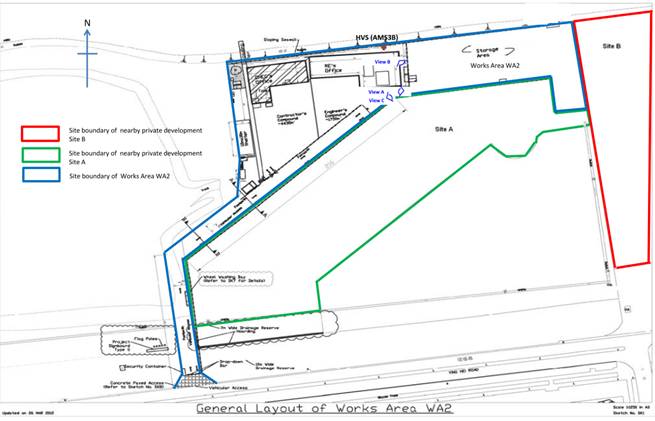
The following dust
mitigation measures have been implemented at Works Area WA2:
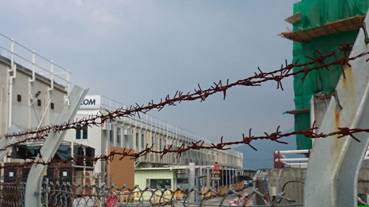
1 Works Area WA2’s surface was hard-paved, compacted or hydro-seeded (Please refer to above layout map and photo records below (View A))
· Photo record taken on 7 November 2014 during ad hoc site inspection: View B on layout map

· Photo record taken on 7 November 2014 during ad hoc site inspection: View C on layout map
2 Vehicle washing facility was provided at vehicle exit points,
3 Measures for preventing fugitive dust emission are provided, e.g. canvas/tarpaulin covers.
2.7.3.9 After investigation, the dust exceedance was considered not to be due to works of this Contract.
2.7.4
The event action plan is annexed in Appendix L.
2.7.5
Meteorological information collected from the wind
station during the monitoring periods on the monitoring dates, as shown in
Figure 2, including wind speed and wind direction, is annexed in Appendix H.
3
Noise MONITORING
3.1
Monitoring
Requirements
3.1.1
In accordance with the Project Specific EM&A
Manual, impact noise monitoring was conducted for at least once per week during
the construction phase of the Project. The Action and Limit level of the noise
monitoring is provided in Appendix D.
3.2
Monitoring Equipment
3.2.1
Noise monitoring was performed using sound level meter
at each designated monitoring station. The sound level meters deployed
comply with the International Electrotechnical Commission Publications (IEC)
651:1979 (Type 1) and 804:1985 (Type 1) specifications. Acoustic
calibrator was deployed to check the sound level meters at a known sound
pressure level. Brand and model of the equipment is given in Table 3.1.
Table 3.1 Noise Monitoring Equipment
|
Equipment |
Brand and Model |
|
Integrated Sound Level Meter |
Rion NL-31 & B&K2238 |
|
Acoustic Calibrator |
Rion NC-74 & B&K 4231 |
3.3
Monitoring Locations
3.3.1
Monitoring locations NMS2 was set up at the proposed
locations in accordance with Project Specific EM&A Manual. However, for monitoring
location NMS3 (Ho Yu College), as proposed in the Project Specific EM&A
Manual, approval for carrying out impact monitoring could not be obtained from
the principal of the school. Permission on setting up and carrying out impact
monitoring works at nearby sensitive receivers, like Caribbean Coast and
Coastal Skyline, was also sought. However, approvals for carrying out
impact monitoring works within their premises were not obtained. Impact noise
monitoring was conducted at site boundary of the site office area in Works Area
WA2 (NMS3B) respectively. Same baseline noise level (as derived from the
baseline monitoring data recorded at Ho Yu College) and Limit Level were
adopted for this alternative noise monitoring location.
3.3.2
Figure 2 shows the locations of the monitoring
stations. Table 3.2 describes the details of the monitoring stations.
Table 3.2 Locations of Impact Noise Monitoring Stations
|
Monitoring Station |
Location |
Description |
|
NMS2 |
Seaview Crescent Tower 1 |
Free-field on the rooftop of the premise |
|
NMS3B |
Site Boundary of Site Office Area at Works Area WA2 |
Free-field on ground at the area boundary. |
3.4
Monitoring
Parameters, Frequency and Duration
3.4.1
Table 3.3 summarizes the monitoring parameters,
frequency and duration of impact noise monitoring.
Table 3.3 Noise Monitoring Parameters, Frequency and Duration
|
Parameter |
Frequency and Duration |
|
30-mins measurement at each monitoring station between 0700 and 1900 on normal weekdays (Monday to Saturday). Leq, L10 and L90 would be recorded. |
At least once per week |
3.5
Monitoring
Methodology
3.5.1
Monitoring Procedure
(a) The sound level meter was set on a tripod at a height of 1.2 m above the ground for free-field measurements at NMS2. A correction of +3 dB(A) shall be made to the free field measurements.
(b) All measurement at NMS3B were free field measurements in the reporting month at NMS3B. A correction of +3 dB(A) shall be made to the free field measurements.
(c) The battery condition was checked to ensure the correct functioning of the meter.
(d) Parameters such as frequency weighting, the time weighting and the measurement time were set as follows:-
(i) frequency weighting: A
(ii) time weighting: Fast
(iii) time measurement: Leq(30-minutes) during non-restricted hours i.e. 07:00 – 1900 on normal weekdays.
(e) Prior to and after each noise measurement, the meter was calibrated using the acoustic calibrator for 94dB(A) at 1000 Hz. If the difference in the calibration level before and after measurement was more than 1 dB(A), the measurement would be considered invalid and repeat of noise measurement would be required after re-calibration or repair of the equipment.
(f) During the monitoring period, the Leq, L10 and L90 were recorded. In addition, site conditions and noise sources were recorded on a standard record sheet.
(g) Noise measurement was paused during periods of high intrusive noise (e.g. dog barking, helicopter noise) if possible. Observations were recorded when intrusive noise was unavoidable.
(h) Noise monitoring was cancelled in the presence of fog, rain, wind with a steady speed exceeding 5m/s, or wind with gusts exceeding 10m/s. The wind speed shall be checked with a portable wind speed meter capable of measuring the wind speed in m/s.
3.5.2
Maintenance and Calibration
(a) The microphone head of the sound level meter was cleaned with soft cloth at regular intervals.
(b) The meter and calibrator were sent to the supplier or HOKLAS laboratory to check and calibrate at yearly intervals.
(c) Calibration certificates of the sound level meters and acoustic calibrators are provided in Appendix E.
3.6
Monitoring
Schedule for the Reporting Month
3.6.1
The schedule for construction noise monitoring in
October 2014 is provided in Appendix F.
3.7
Monitoring
Results
3.7.1
The monitoring results for construction noise are
summarized in Table 3.4 and the monitoring data is provided in Appendix I.
Table 3.4 Summary of Construction Noise Monitoring Results in the Reporting Period
|
|
Average, dB(A), Leq (30 mins) |
Range, dB(A), Leq (30 mins) |
Limit Level, dB(A), Leq (30 mins) |
|
NMS2 |
67 |
66 – 68* |
75 |
|
NMS3B |
67 |
63 – 68* |
70/65^ |
*+3dB(A) Façade correction included
^ Daytime noise Limit Level of 70 dB(A) applies to education institutions, while 65dB(A) applies during school examination period.
3.7.2
No Action or Limit Level Exceedance of construction
noise was recorded in the reporting month.
3.7.3
Major noise sources during the noise monitoring
included construction activities of the Project, construction activities by
other contracts and nearby traffic noise.
3.7.4
The event action plan is annexed in Appendix L.
4
WATER QUALITY MONITORING
4.1
Monitoring Requirements
4.1.1
Impact water quality monitoring was carried out to
ensure that any deterioration of water quality was detected, and that timely
action was taken to rectify the situation. For impact water quality monitoring,
measurements were taken in accordance with the Project Specific EM&A
Manual. Appendix D shows the established Action/Limit Levels for the
environmental monitoring works.
4.2
Monitoring
Equipment
4.2.1
Table 4.1 summarises the equipment used in the impact
water quality monitoring programme.
Table 4.1 Water Quality Monitoring Equipment
|
Equipment |
Brand and Model |
|
Dissolved Oxygen (DO) and Temperature Meter, Salinity Meter and Turbidimeter |
YSI Model 6820 |
|
pH Meter |
YSI Model 6820 or Thermo Orion 230A+ |
|
Positioning Equipment |
JRC DGPS 224 Model JLR-4341 with J-NAV 500 Model NWZ4551 |
|
Water Depth Detector |
Eagle Cuda-168 and Lowrance x-4 |
|
Water Sampler |
Kahlsio Water Sampler (Vertical) 2.2 L with messenger |
4.3
Monitoring
Parameters, Frequency and Duration
4.3.1
Table 4.2 summarises the monitoring parameters,
frequency and monitoring depths of impact water quality monitoring as required
in the Project Specific EM&A Manual.
Table 4.2 Impact Water Quality Monitoring Parameters and Frequency
|
Monitoring Stations |
Parameter, unit |
Frequency |
No. of depth |
|
Impact Stations: IS5, IS(Mf)6, IS7, IS8, IS(Mf)9, IS10, IS(Mf)11, IS(Mf)16, IS17
Control/Far Field Stations: CS(Mf)3, CS(Mf)5, CS4, CS6, CSA
Sensitive Receiver Stations: SR3-SR7, SR10A&SR10B |
· Depth, m · Temperature, oC · Salinity, ppt · Dissolved Oxygen (DO), mg/L · DO Saturation, % · Turbidity, NTU · pH · Suspended Solids (SS), mg/L |
Three times per week during mid-ebb and mid-flood tides (within ± 1.75 hour of the predicted time)
|
3 (1 m below water surface, mid-depth and 1 m above sea bed, except where the water depth is less than 6 m, in which case the mid-depth station may be omitted. Should the water depth be less than 3 m, only the mid-depth station will be monitored). |
4.4
Monitoring
Locations
4.4.1
In accordance with the Project Specific EM&A
Manual, twenty-one stations (9 Impact Stations, 7 Sensitive Receiver Stations
and 5 Control/Far Field Stations) were designated for impact water quality
monitoring. The nine Impact Stations (IS) were chosen on the basis of their
proximity to the reclamation and thus the greatest potential for water quality
impacts, the seven Sensitive Receiver Stations (SR) were chosen as they are
close to the key sensitive receives and the five Control/ Far Field Stations
(CS) were chosen to facilitate comparison of the water quality of the IS
stations with less influence by the Project/ ambient water quality conditions.
4.4.2
Due to safety concern and topographical condition of
the original locations of SR4 and SR10B, alternative impact water quality
monitoring stations, naming as SR4 (N) and SR10B (N), were adopted, which are
situated in vicinity of the original impact water quality monitoring stations
(SR4 and SR10B) and could be reachable.
4.4.3
Same baseline and Action Level for water quality, as
derived from the baseline monitoring data recorded, were adopted for these
alternative impact water quality monitoring stations.
4.4.4
The locations of these monitoring stations are
summarized in Table 4.3 and depicted in Figure 3.
Table 4.3 Impact Water Quality Monitoring Stations
|
Station |
Description |
East |
North |
|
IS5 |
Impact Station (Close to HKBCF construction site) |
811579 |
817106 |
|
IS(Mf)6 |
Impact Station (Close to HKBCF construction site) |
812101 |
817873 |
|
IS7 |
Impact Station (Close to HKBCF construction site) |
812244 |
818777 |
|
IS8 |
Impact Station (Close to HKBCF construction site) |
814251 |
818412 |
|
IS(Mf)9 |
Impact Station (Close to HKBCF construction site) |
813273 |
818850 |
|
IS10 |
Impact Station (Close to HKBCF construction site) |
812577 |
820670 |
|
Impact Station (Close to HKBCF construction site) |
813562 |
820716 |
|
|
Impact Station (Close to HKBCF construction site) |
814328 |
819497 |
|
|
IS17 |
Impact Station (Close to HKBCF construction site) |
814539 |
820391 |
|
SR3 |
Sensitive receivers (San Tau SSSI) |
810525 |
816456 |
|
SR4(N) |
Sensitive receivers (Tai Ho) |
814705 |
817859 |
|
SR5 |
Sensitive receivers (Artificial Reef in NE Airport) |
811489 |
820455 |
|
SR6 |
Sensitive receivers (Sha Chau and Lung Kwu Chau Marine Park) |
805837 |
821818 |
|
SR7 |
Sensitive receivers (Tai Mo Do) |
814293 |
821431 |
|
SR10A |
Sensitive receivers (Ma Wan FCZ)1 |
823741 |
823495 |
|
SR10B(N) |
Sensitive receivers (Ma Wan FCZ)2 |
823683 |
823187 |
|
Control Station |
809989 |
821117 |
|
|
Control Station |
817990 |
821129 |
|
|
CS4 |
Control Station |
810025 |
824004 |
|
CS6 |
Control Station |
817028 |
823992 |
|
CSA |
Control Station |
818103 |
823064 |
4.5
Monitoring
Methodology
4.5.1
Instrumentation
(a) The in-situ water quality parameters, viz. dissolved oxygen, temperature, salinity, turbidity and pH, were measured by multi-parameter meters (i.e. Model YSI 6820 CE-C-M-Y) and pH meter (i.e. Thermo Orion 230A+) respectively.
4.5.2
Operating/Analytical Procedures
(a) Digital Differential Global Positioning Systems (DGPS) were used to ensure that the correct location was selected prior to sample collection.
(b) Portable, battery-operated echo sounders were used for the determination of water depth at each designated monitoring station.
(c) All in-situ measurements were taken at 3 water depths, 1 m below water surface, mid-depth and 1 m above sea bed, except where the water depth was less than 6 m, in which case the mid-depth station was omitted. Should the water depth be less than 3 m, only the mid-depth station was monitored.
(d) At each measurement/sampling depth, two consecutive in-situ monitoring (DO concentration and saturation, temperature, turbidity, pH, salinity) and water sample for SS. The probes were retrieved out of the water after the first measurement and then re-deployed for the second measurement. Where the difference in the value between the first and second readings of DO or turbidity parameters was more than 25% of the value of the first reading, the reading was discarded and further readings were taken.
(e) Duplicate samples from each independent sampling event were collected for SS measurement. Water samples were collected using the water samplers and the samples were stored in high-density polythene bottles. Water samples collected were well-mixed in the water sampler prior to pre-rinsing and transferring to sample bottles. Sample bottles were pre-rinsed with the same water samples. The sample bottles were then be packed in cool-boxes (cooled at 4oC without being frozen), and delivered to ALS Technichem (HK) Pty Ltd. for the analysis of suspended solids concentrations. The laboratory determination work would be started within 24 hours after collection of the water samples. ALS Technichem (HK) Pty Ltd. is a HOKLAS accredited laboratory and has comprehensive quality assurance and quality control programmes. For QA/QC procedures, one duplicate samples of every batch of 20 samples was analyzed.
(f) The analysis method and reporting and detection limit for SS is shown in Table 4.4.
Table 4.4 Laboratory Analysis for Suspended Solids
|
Parameters |
Instrumentation |
Analytical Method |
Reporting Limit |
Detection Limit |
|
Suspended Solid (SS) |
Weighting |
APHA 2540-D |
0.5mg/L |
0.5mg/L |
(g) Other relevant data were recorded, including monitoring location / position, time, water depth, tidal stages, weather conditions and any special phenomena or work underway at the construction site in the field log sheet for information.
4.5.3
Maintenance and Calibration
(a) All in situ monitoring instruments would be calibrated and calibrated by ALS Technichem (HK) Pty Ltd. before use and at 3-monthly intervals throughout all stages of the water quality monitoring programme. Calibration details are provided in Appendix E.
(b) The dissolved oxygen probe of YSI 6820 was calibrated by wet bulb method. Before the calibration routine, the sensor for dissolved oxygen was thermally equilibrated in water-saturated air. Calibration cup is served as a calibration chamber and it was loosened from airtight condition before it is used for the calibration. Calibration at ALS Technichem (HK) Pty Ltd. was carried out once every three months in a water sample with a known concentration of dissolved oxygen. The sensor was immersed in the water and after thermal equilibration, the known mg/L value was keyed in and the calibration was carried out automatically.
(c) The turbidity probe of YSI 6820 is calibrated two times a month. A zero check in distilled water was performed with the turbidity probe of YSI 6820 once per monitoring day. The probe will be calibrated with a solution of known NTU at ALS Technichem (HK) Pty Ltd. once every three months.
4.6
Monitoring Schedule for the Reporting Month
4.6.1
The schedule for impact water quality monitoring in
October 2014 is provided in Appendix F.
4.7
Results
and Observations
4.7.1
Impact water quality monitoring results and graphical
presentations are provided in Appendix J.
4.7.2
A total
of (18) eighteen exceedances were recorded in this reporting month: (1) One
Limit Level Exceedance of Turbidity and (1) Limit Level Exceedance of Suspended
Solids were recorded at IS17 during ebb tide on 10 October 2014; (1) One Action
Level Exceedance of SS at SR10B(N) was recorded on10 October 2014 during flood
tide; (1) One Action Level Exceedance of SS at IS8 was recorded on 3 October
2014 during flood tide; (1) One Action Level Exceedance of SS at IS(Mf)11 was
recorded on 6 October 2014 during ebb tide; (2) Two Action Level Exceedances of
SS at IS(Mf)11 and SR5 were recorded on 6 October 2014 during flood tide; (3)
Three Action Level Exceedances of SS were recorded at IS10, SR4(N) and SR5 on
13 October 2014 during flood tide; (1) One Action Level Exceedance of SS was
recorded at IS17 on 20 October 2014 during ebb tide; (1) action level
exceedance and (1) limit level exceedance of SS were recorded at SR4(N) and IS8
respectively on 20 October 2014 during flood tide; (2) Two Action Level
Exceedances of SS were recorded at SR10A and SR10B(N) on 22 October 2014 during
flood tide; (2) Two Action Level Exceedances of SS were recorded at IS10 and
SR4(N) during flood tide on 24 October 2014. (1) Action Level Exceedance was
recorded at IS8 on 31 October 2014 during ebb tide.
Table 4.5 Summary of Water Quality Exceedances
|
Exceedance Level |
DO (S&M) |
DO (Bottom) |
Turbidity |
SS |
Total |
||||||
|
Ebb |
Flood |
Ebb |
Flood |
Ebb |
Flood |
Ebb |
Flood |
Ebb |
Flood |
||
|
Action |
0 |
0 |
0 |
0 |
0 |
0 |
0 |
0 |
0 |
0 |
|
|
Limit |
0 |
0 |
0 |
0 |
0 |
0 |
0 |
0 |
0 |
0 |
|
|
IS(Mf)6 |
Action |
0 |
0 |
0 |
0 |
0 |
0 |
0 |
0 |
0 |
0 |
|
Limit |
0 |
0 |
0 |
0 |
0 |
0 |
0 |
0 |
0 |
0 |
|
|
IS7 |
Action |
0 |
0 |
0 |
0 |
0 |
0 |
0 |
0 |
0 |
0 |
|
Limit |
0 |
0 |
0 |
0 |
0 |
0 |
0 |
0 |
0 |
0 |
|
|
IS8 |
Action |
0 |
0 |
0 |
0 |
0 |
0 |
(1) 31 Oct 14 |
(1) 3 Oct 14 |
1 |
1 |
|
Limit |
0 |
0 |
0 |
0 |
0 |
0 |
0 |
(1) 20 Oct 14 |
0 |
1 |
|
|
IS(Mf)9 |
Action |
0 |
0 |
0 |
0 |
0 |
0 |
0 |
0 |
0 |
0 |
|
Limit |
0 |
0 |
0 |
0 |
0 |
0 |
0 |
0 |
0 |
0 |
|
|
IS10 |
Action |
0 |
0 |
0 |
0 |
0 |
0 |
0 |
(2) 13 and 24 Oct 14 |
0 |
2 |
|
Limit |
0 |
0 |
0 |
0 |
0 |
0 |
0 |
0 |
0 |
0 |
|
|
IS(Mf)11 |
Action |
0 |
0 |
0 |
0 |
0 |
0 |
(1) 6 Oct 14 |
(1) 6 Oct 14 |
1 |
1 |
|
Limit |
0 |
0 |
0 |
0 |
0 |
0 |
0 |
0 |
0 |
0 |
|
|
IS(Mf)16 |
Action |
0 |
0 |
0 |
0 |
0 |
0 |
0 |
0 |
0 |
0 |
|
Limit |
0 |
0 |
0 |
0 |
0 |
0 |
0 |
0 |
0 |
0 |
|
|
IS17 |
Action |
0 |
0 |
0 |
0 |
0 |
0 |
(1) 20 Oct |
0 |
1 |
0 |
|
Limit |
0 |
0 |
0 |
0 |
(1) 10 Oct 14 |
0 |
(1) 10 Oct |
0 |
2 |
0 |
|
|
SR3 |
Action |
0 |
0 |
0 |
0 |
0 |
0 |
0 |
0 |
0 |
0 |
|
Limit |
0 |
0 |
0 |
0 |
0 |
0 |
0 |
0 |
0 |
0 |
|
|
SR4(N) |
Action |
0 |
0 |
0 |
0 |
0 |
0 |
0 |
(3) 13, 20 and 24 Oct 14 |
0 |
3 |
|
Limit |
0 |
0 |
0 |
0 |
0 |
0 |
0 |
0 |
0 |
0 |
|
|
SR5 |
Action |
0 |
0 |
0 |
0 |
0 |
0 |
0 |
(2) 6 and 13 Oct 14 |
0 |
2 |
|
Limit |
0 |
0 |
0 |
0 |
0 |
0 |
0 |
0 |
0 |
0 |
|
|
SR6 |
Action |
0 |
0 |
0 |
0 |
0 |
0 |
0 |
0 |
0 |
0 |
|
Limit |
0 |
0 |
0 |
0 |
0 |
0 |
0 |
0 |
0 |
0 |
|
|
SR7 |
Action |
0 |
0 |
0 |
0 |
0 |
0 |
0 |
0 |
0 |
0 |
|
Limit |
0 |
0 |
0 |
0 |
0 |
0 |
0 |
0 |
0 |
0 |
|
|
SR10A |
Action |
0 |
0 |
0 |
0 |
0 |
0 |
0 |
(1) 22 Oct 14 |
0 |
1 |
|
Limit |
0 |
0 |
0 |
0 |
0 |
0 |
0 |
0 |
0 |
0 |
|
|
SR10B (N) |
Action |
0 |
0 |
0 |
0 |
0 |
0 |
0 |
(2) 10 and 22 Oct 14 |
0 |
2 |
|
Limit |
0 |
0 |
0 |
0 |
0 |
0 |
0 |
0 |
0 |
0 |
|
|
Total |
Action |
0 |
0 |
0 |
0 |
0 |
0 |
3 |
12 |
15 |
|
|
|
Limit |
0 |
0 |
0 |
0 |
1 |
0 |
1 |
1 |
3 |
|
Note: S: Surface; and
M: Mid-depth.
4.7.3
(1) One Limit Level Exceedance of
Turbidity and (1) Limit Level Exceedance of Suspended Solids were recorded at
IS17 during ebb tide on 10 October 2014. Exceedances recorded at IS17 are
likely due to marine based construction activities of the Project because:
4.7.3.1 With refer to monitoring record, appearance of water was relatively more
turbid at IS17 when compared with the appearance of water at IS(Mf)11, IS10 and
IS(Mf)16 during monitoring at ebb tide on 10 Oct 14.
4.7.3.2 As informed by the Contractor, sand
filling was carried out at Portion E2 on 8, 10 and 13 Oct 14 at almost
the same location but no exceedance was recorded at monitoring station IS17 on
8 and 13 Oct 14 during mid ebb tide. This indicates filling works were unlikely
to cause the exceedance in turbidity at monitoring station IS17.

4.7.3.3 The source of impact is likely due
pelican barge's propeller movement at shallow water during ebb tide when the
position of the barge was adjusted at portion E. In addition, with refer to the
silt curtain condition on 10 Oct 14, defects of the perimeter silt curtain was
observed at northwest of the construction site. The dispersion of turbid water
from the inside of the perimeter silt curtain to the outside of the perimeter
silt curtain is potentially due to defects of northwest part of the perimeter
silt curtain.
4.7.3.4 Action taken under the event and
action plan
1. in situ measurement was repeated to confirm findings of the exceedance of turbidity. Repeat in situ measurement is not applicable to suspended solid as SS was not measured in situ;
2. Source of impact refer to Section 4.7.3.3
3. IEC, Contractor, ER and EPD were noticed of the limit level exceedances via email;
4. Monitoring data was reviewed, plant, equipment and contractor's working methods were checked. Please refer to the layout map above.
5. The Contractor was reminded to ensure swift provision of ongoing maintenance to the silt curtains and to carry out maintenance work once defects were found.
6. Mitigation measures such as perimeter silt curtain was implemented by the Contractor, however defects of the perimeter silt curtain was observed, the Contractor was reminded to ensure swift provision of maintenance to the silt curtains once defects were found. With refer to the maintenance record provided by the Contractor, maintenance work for the defects of the northwest part of the perimeter silt curtain was conducted on 28 October 2014.
7. Monitoring results show no recurrence of exceedance at IS17 during ebb tide on 13 Oct 2014.
4.7.3.5 ET’s conclusions and recommendations
for mitigation: Exceedances recorded at IS17 are likely to be related to vessel
movement at shallow water during ebb tide. The Contractor was further reminded
to control the vessel traffic at this area and ensure swift provision of maintenance
to the silt curtains once defect was found.
4.7.3.6 Contractor’s actions to implement
the mitigation: As informed by the Contractor, traffic control such as vessel
speed limit was implemented and operation of sand filling vessel at shallow water
during ebb tide was avoided. Monitoring results show no recurrence of
exceedance at IS17 on 13 Oct 2014.
4.7.3.7 With refer to the maintenance record
provided by the Contractor, maintenance work for the defects of the northwest
part of the perimeter silt curtain was conducted on 28 October 2014.
4.7.4
(1) One Action Level Exceedance of SS at
SR10B(N) was recorded on 10 October 2014 during flood tide and exceedance was
not due to marine based construction works of the Project because:
4.7.4.1 IS(Mf)11 and IS10 are located
downstream and closer to the active works than monitoring station SR10B(N)
during flood tide. Depth Averaged Suspended Solids (SS) values (in mg/L)
recorded during flood tide on the same day at IS(Mf)11 and IS10 were below
the Action and Limit Level which indicates project work is unlikely to
contribute to the action level exceedance recorded at SR10B(N).
4.7.4.2 The monitoring location of
monitoring station SR10B(N) are considered upstream and remote to the active
works of this project during flood tide. Therefore it was unlikely that the
exceedance recorded at SR10B(N) during flood tide was due to active construction
activities of this project.
4.7.4.3 The exceedance was likely due to
local effects in the vicinity of SR10B(N).
Action taken under the action plan
1. Not applicable as SS was not measured in situ;
2. After considering the above mentioned investigation results, it appears that it was unlikely that the SS exceedance was attributed to active construction activities of this project;
3. IEC, contractor and ER were informed via email;
4. Monitoring data, all plant, equipment and Contractor's working methods were checked;
5. Since it is considered that the SS exceedance is unlikely to be project related, as such, actions 5 - 7 under the EAP are not considered applicable.
4.7.4.4 ET’s conclusions and recommendations
for mitigation: Exceedance was not due to marine
based construction works of the Project. Nevertheless, the Contractor
was reminded to ensure provision of ongoing maintenance to the silt curtains
and to carry out maintenance work once defects were found.
Contractor’s actions to implement the mitigation
4.7.4.5 As informed by the Contractor,
maintenance work of the silt curtain is on-going and carried out by the
Contractor on a daily basis.
4.7.5
(1) One Action Level Exceedance of
SS at IS8 was recorded on 3 October 2014 during flood tide;
4.7.5.1 Layout map for work activities carried out on 03
October 14 is showed below:
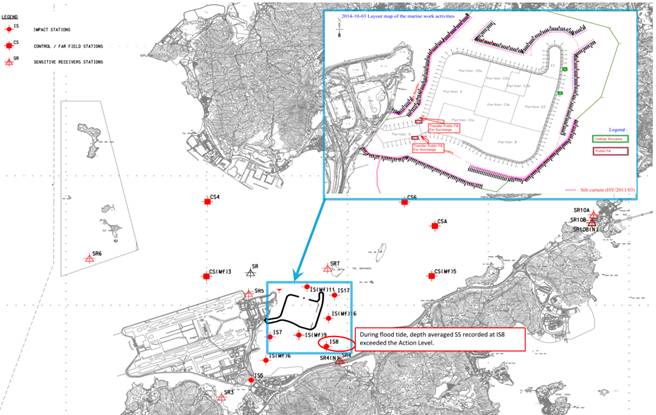
4.7.5.2 Exceedance recorded at IS8 during mid-flood tide is
unlikely due to marine based construction activities of the Project because:
4.7.5.3 With reference to the information provided by the
Contractor, only cellular structure installation was conducted at the northeast
part of the HKBCF reclamation works during mid flood tide, but cellular
structure installation is unlikely to cause silt plume and contribute to the elevation
of SS at IS8 during flood tide.
4.7.5.4 IS(Mf)9 and IS(Mf)16 are located closer to the active
works than monitoring station IS8. Depth Averaged Suspended Solids (SS) values
(in mg/L) recorded during the flood tide on the same day at IS(Mf)9 and
IS(Mf)16 were below the Action and Limit Level which shows that the water
quality closer to active works was not adversely affected.
4.7.5.5 In accordance with the silt curtain integrity checking
record of 3 October 2014, disconnection of the perimeter silt curtain was
observed at the southeast part of HKBCF Reclamation Works, but with referred to
monitoring record and photo record below, no sediment plume has been observed
to flow from the inside of the perimeter silt curtain to the outside of the perimeter
silt curtain and no discoloration of sea water has been observed. (Please
refer to below photo). In accordance with the silt curtain integrity checking
record, the observed disconnection was rectified on 6 October 2014
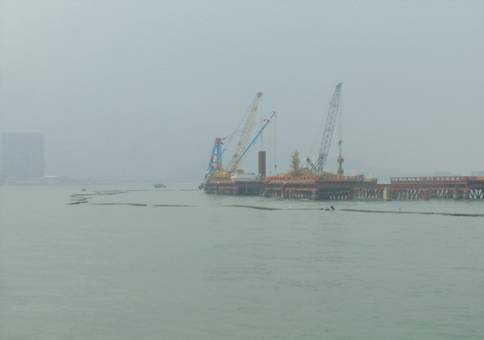
4.7.5.6 Photo record above shows the sea condition taken during
flood tide at HKBCF Reclamation Works near IS8 on 3 October 2014.
4.7.5.7 Turbidity level recorded at IS8, IS(Mf)9 and IS(Mf)16
were below the action and limit level. This indicates the turbidity level at
area near IS8 was not adversely affected.
4.7.5.8 The exceedance was likely due to local effects in the
vicinity of IS8.
4.7.5.9 As such, the exceedance recorded at IS8 is unlikely to
be project related.
4.7.5.10
Action taken under the event and action
plan:
1. Not applicable as SS was not measured in situ;
2. After considering the above mentioned investigation results, it appears that it was unlikely that the SS exceedance was attributed to active construction activities of this project;
3. IEC, contractor and ER were informed via email;
4. Monitoring data, all plant, equipment and Contractor's working methods were checked;
5-7. Since it is considered that the SS exceedance is unlikely to be project related, as such, actions 5 - 7 under the EAP are not considered applicable.
4.7.5.11
ET’s conclusions and recommendations for
mitigation: Nevertheless, the Contractor was reminded to ensure provision of
ongoing maintenance to the silt curtains and to carry out maintenance work once
defects were found.
4.7.5.12
Contractor’s actions to implement the
mitigation: As informed by the Contractor, maintenance work of the silt curtain
is on-going and carried out by the Contractor on a daily basis.
4.7.6 (1) One Action Level Exceedance of SS at IS(Mf)11 was recorded on 6
October 2014 during ebb tide; (2) Two Action Level Exceedances of SS at
IS(Mf)11 and SR5 were recorded on 6 October 2014 during flood tide;
4.7.6.1 Layout map below shows active works
conducted on 6-Oct-14. Works such as cellular structure installation was
conducted at north part of the HKBCF Reclamation Works and sand filling was
conducted at Portion E2 when monitoring was conducted.
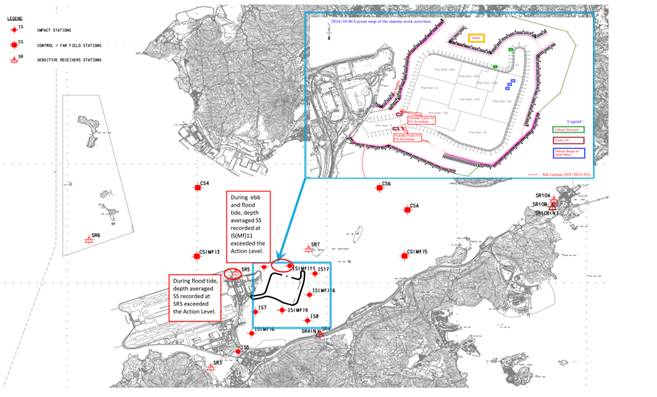
4.7.6.2 Exceedance recorded at SR5 during
mid-flood tide are unlikely due to marine based construction activities of the
Project because:
4.7.6.3 With reference to the silt curtain
checking record defects was observed at parts of the perimeter silt curtain which
are close to the SR5.
4.7.6.4 With reference to the information
provided by the Contractor, same types of work were carried out at almost the
same locations on 3, 6 and 8 October 2014, impact water quality monitoring data
recorded on 3 and 8 October 2014 at SR5 are all below the Action and Limit
Level which indicates exceedance at SR5 was unlikely due to active works.
4.7.6.5 The location of monitoring station
IS10 is located downstream and closer to active works than SR5 but no
exceedance was recorded at IS10 during flood tide. This the acton level
exceedance of SS at SR5 is unlikely attribute to active construction works.
4.7.6.6 Turbidity level recorded at SR5,
IS10 and IS(Mf)11 recorded on 6 October 2014 were below the action and limit
level. This indicates the turbidity level at area near SR5 was not adversely
affected.
4.7.6.7 With refer to monitoring record, no
silt plumes was observed when monitoring is conducted in SR5.
4.7.6.8 The exceedance was likely due to
local effects in the vicinity of SR5.
4.7.6.9 Exceedances recorded at IS(Mf)11
during ebb and flood tide are unlikely due to marine based construction
activities of the Project because:
4.7.6.10
With reference to the information provided by the Contractor,
same types of work were carried out at almost the same locations on 3, 6 and 8
October 2014, impact water quality monitoring data recorded on 3 and 8 October
2014 at IS(Mf)11 are all below the Action and Limit Level which indicates
exceedance were unlikely due to active works.
4.7.6.11
With reference to the silt curtain checking record
defects was observed at parts of the perimeter silt curtain which are close to
the IS(Mf)11. As informed by the Contractor, maintenance work of the silt curtain
is on-going and carried out by the Contractor on a daily basis.
4.7.6.12
Turbidity level recorded at SR5, IS10, IS(Mf)11 and
IS17 recorded on 6 October 2014 were below the action and limit level. This
indicates the turbidity level at area near IS(Mf)11 was not adversely affected.
4.7.6.13
With refer to monitoring record, no dispersion of
turbid water from the inside of the perimeter silt curtain to the outside of
the perimeter silt curtain or silt plumes was observed when monitoring is
conducted in IS(Mf)11.
4.7.6.14
The exceedances were likely due to local effects in
the vicinity of IS(Mf)11.
4.7.6.15
After investigation, there is no adequate information
to conclude the recorded exceedances are related to this
Contract.
4.7.6.16
Action taken under the event and action plan:
1. Not applicable as SS was not measured in situ;
2. After considering the above mentioned investigation results, it appears that it was unlikely that the SS exceedances were attributed to active construction activities of this project;
3. IEC, contractor and ER were informed via email;
4. Monitoring data, all plant, equipment and Contractor's working methods were checked;
5-7. Since it is considered that the SS exceedances are unlikely to be project related, as such, actions 5 - 7 under the EAP are not considered applicable.
4.7.6.17
ET’s conclusions and recommendations for mitigation:
Mitigation measures such as perimeter silt curtain was implemented by the
Contractor, however defects of the perimeter silt curtain was observed, the
Contractor was reminded to ensure swift provision of maintenance to the silt
curtains once defects were found.
4.7.6.18
Contractor’s actions to implement the mitigation: With
refer to the maintenance record provided by the Contractor, maintenance work
for the defects of the northwest part of the perimeter silt curtain was
conducted on 28 October 2014.
4.7.6.19
Photo shows sea condition at northwest part of HKBCF
reclamation works on 6 Oct 2014 during ebb tide
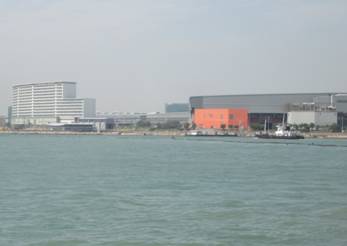
4.7.7 (3) Three Action Level Exceedances of SS were recorded at IS10, SR4(N)
and SR5 on 13 October 2014 during flood tide;
4.7.7.1 Layout map below shows active works
conducted on 13-Oct-14. Works such as construction works for cellular structure
were conducted at northeast part of the HKBCF Reclamation Works.
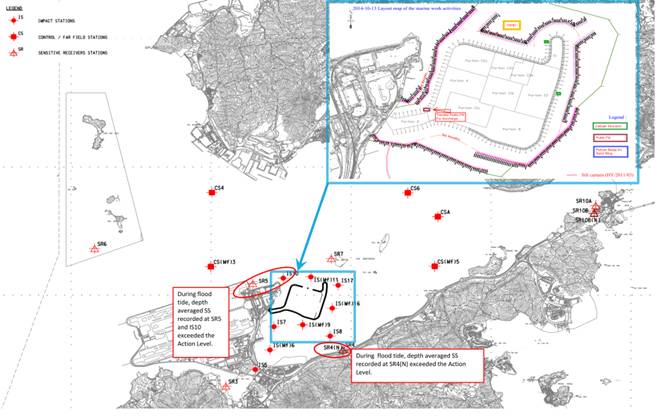
4.7.7.2 Exceedance recorded at IS10 and SR5
during mid-flood tide are unlikely due to marine based construction activities
of the Project because:
4.7.7.3 With reference to the silt curtain checking
record, defects was observed at parts of the perimeter silt curtain which are
close to the IS10 and SR5.
4.7.7.4 With reference to the information
provided by the Contractor, active construction works were carried out at
locations closer to SR5 and IS10 on 10 October 2014. There were more active
construction works carried out on 15 October 2014 during the same tide, impact
water quality monitoring data recorded on 10 and 15 October 2014 at SR5 and
IS10 are all below the Action and Limit Level which indicate exceedances at SR5
and IS10 were unlikely due to active construction works for cellular structure.
4.7.7.5 Relative more turbid water were
observed at IS10 and SR5 during flood tide but no filling activities was
observed in progress and no silt plume was observed to flow from the inside of
the perimeter silt curtain to the outside of the perimeter silt curtain when
monitoring was conducted at IS10 and SR5.
4.7.7.6 Also, turbidity level recorded at SR5,
IS10 and IS(Mf)11 were below the action and limit level. This indicates the
turbidity level at area near SR5 and IS10 was not adversely affected.
4.7.7.7 The exceedance was likely due to
local effects in the vicinity of SR5 and IS10.
4.7.7.8 Exceedance recorded at SR4(N) during
flood tide IS unlikely due to marine based construction activities of the
Project because:
4.7.7.9 With reference to the silt curtain
checking record defects was not observed at southeast part of the perimeter
silt curtain which the closest to SR4(N).
4.7.7.10
The SS level recorded at IS(Mf)9, IS8 and IS(Mf)16
which located closer to active works were below the action and limit level
which indicates exceedance at SR4(N) were unlikely due to active construction
works for cellular structure.
4.7.7.11
Turbidity level recorded at SR4(N), IS(Mf)9, IS8 and
IS(Mf)16 were below the action and limit level. This indicates the turbidity
level at area near IS(Mf)11 was not adversely affected.
4.7.7.12
The exceedances were likely due to local effects in
the vicinity of SR4(N).
4.7.7.13
After investigation, there is no adequate information
to conclude the recorded exceedances are related to this Contract.
4.7.7.14
Action taken under the event and action plan:
1. Not applicable as SS was not measured in situ;
2. After considering the above mentioned investigation results, it appears that it was unlikely that the SS exceedances were attributed to active construction activities of this project;
3. IEC, contractor and ER were informed via email;
4. Monitoring data, all plant, equipment and Contractor's working methods were checked;
5-7. Since it is considered that the SS exceedances are unlikely to be project related, as such, actions 5 - 7 under the EAP are not considered applicable.
4.7.7.15
ET’s conclusions and recommendations for mitigation:
Mitigation measures such as perimeter silt curtain was implemented by the
Contractor, however defects of the perimeter silt curtain was observed, the
Contractor was reminded to ensure swift provision of maintenance to the silt
curtains once defects were found.
4.7.7.16
Contractor’s actions to implement the mitigation: With
refer to the maintenance record provided by the Contractor, maintenance work
for the defects of the northwest part of the perimeter silt curtain was
conducted on 28 October 2014.
4.7.8 (1) One Action Level Exceedance of SS was recorded at IS17 on 20 October
2014 during ebb tide, layout map below shows active works conducted on
20-Oct-14 during ebb tide:
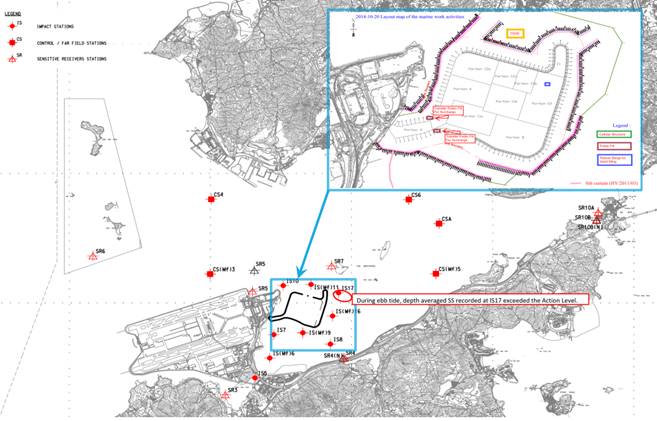
4.7.8.1 Exceedance recorded at IS17 is
likely due to marine based construction activities of the Project because:
4.7.8.2 With refer to monitoring record,
appearance of water was relatively more turbid at IS17 when compared with the
appearance of water at IS(Mf)11, IS10 and IS(Mf)16 during monitoring at ebb
tide on 20-Oct-14.
4.7.8.3 With refer to the layout map above;
sand filling was carried out at Portion E2 on 20-Oct-14 during ebb tide.
4.7.8.4 The source of impact is likely due
pelican barge's propeller movement at shallow water during ebb tide when the
position of the barge was adjusted at Portion E. In addition, with refer to the
silt curtain condition on 20-Oct-14, defects of the perimeter silt curtain was
observed at Northeastern of the construction site. The turbid water observed at
IS17 is likely due to the dispersion of turbid water from the inside of the
perimeter silt curtain to the outside of the perimeter silt curtain through the
defective part of the perimeter silt curtain.
4.7.8.5 Action taken under the event and
action plan
1. Repeat in situ measurement is not applicable to suspended solid as SS was not measured in situ;
2. Source of impact refer to bullet point section 4.7.8.4
3. IEC, Contractor, ER and EPD were noticed of the limit level exceedances via email;
4. Monitoring data was reviewed, plant, equipment and contractor's working methods were checked. Please refer to the layout map above.
5. The Contractor was reminded to ensure swift provision of ongoing maintenance to the silt curtains and to carry out maintenance work once defects were found.
6. Mitigation measures such as perimeter silt curtain was implemented by the Contractor, however defects of the perimeter silt curtain was observed, the Contractor was reminded to ensure swift provision of maintenance to the silt curtains once defects were found. With refer to the maintenance record provided by the Contractor, maintenance work for the defects of the Northeastern part of the perimeter silt curtain was conducted on 28-Oct-14.
7. Monitoring results show no recurrence of exceedance at IS17 during ebb tide on 22 Oct 2014.
4.7.8.6 ET’s conclusions and recommendations
for mitigation: Exceedances recorded at IS17 are likely to be related to vessel
movement at shallow water during ebb tide. The Contractor was further reminded
to control the vessel traffic at this area and ensure swift provision of
maintenance to the silt curtains once defect was found.
4.7.8.7 Contractor’s actions to implement
the mitigation: As informed by the Contractor, traffic control such as vessel
speed limit was implemented and operation of sand filling vessel at shallow
water during ebb tide was avoided. Monitoring results show no recurrence of
exceedance at IS17 on 22-Oct-14.
4.7.8.8 With refer to the maintenance record
provided by the Contractor, maintenance work for the defects of the
Northeastern part of the perimeter silt curtain was conducted on 28-Oct-14.
4.7.9 (1) One action level exceedance and (1) limit level exceedance of SS
were recorded at SR4(N) and IS8 respectively on 20 October 2014 during flood
tide;
4.7.9.1 Layout map below shows active works
conducted on 20-Oct-14 during flood tide.
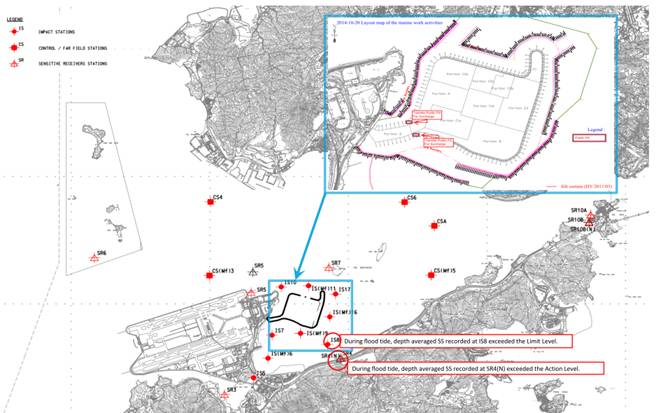
4.7.9.2 With reference to the information
provided by the Contractor, only public fill was transferred at Portion D for
surcharge on 20 October 2014 during flood tide and no active marine
construction activity from this Contract was conducted near IS8, as such, it is
unlikely to cause silt plume and contribute to the elevation of SS at IS8
during flood tide.
4.7.9.3 IS(Mf)9 is located closer to the
construction site than monitoring station IS8. Depth Averaged Suspended Solids
(SS) values (in mg/L) recorded during the flood tide on the same day at IS(Mf)9
was below the Action and Limit Level which shows that the water quality closer
to construction site was not adversely affected.
4.7.9.4 In accordance with the silt curtain
integrity checking record of 20 October 2014, no defect of the perimeter silt
curtain was observed at the southeast part of HKBCF Reclamation Works. In
addition, with referred to monitoring record , no sediment plume has been
observed to flow from the inside of the perimeter silt curtain to the outside
of the perimeter silt curtain and no discoloration of sea water has been
observed at IS8.
4.7.9.5 Turbidity level recorded at IS8,
IS(Mf)9 and IS(Mf)16 were below the action and limit level. This indicates the
turbidity level at area near IS8 was not adversely affected.
4.7.9.6 The exceedance was likely due to
local effects in the vicinity of IS8.
4.7.9.7 As such, the exceedance recorded at
IS8 is unlikely to be project related.
4.7.9.8 Exceedance recorded at SR4(N) during
flood tide is unlikely due to marine based construction activities of the
Project because:
4.7.9.9
With reference to the information provided by the
Contractor, only public fill was transferred at Portion D for surcharge on 20
October 2014 during flood tide and no active marine construction activity from
this Contract was conducted near SR4(N), as such, it is unlikely to cause silt
plume and contribute to the elevation of SS at SR4(N) during flood tide.
4.7.9.10
With reference to the silt curtain checking record
defects was not observed at southeast part of the perimeter silt curtain which
the closest to SR4(N) on 20 October 2014.
4.7.9.11
The SS level recorded at IS(Mf)9, IS8 and IS(Mf)16
which located closer to active works were below the action and limit level on
20 October 2014 which indicates exceedance at SR4(N) was unlikely due to active
construction works for cellular structure .
4.7.9.12
Turbidity level recorded at SR4(N), IS(Mf)9, IS8 and
IS(Mf)16 on 20 October 2014 were below the action and limit level. This
indicates the turbidity level at area near IS(Mf)11 was not adversely affected.
4.7.9.13
The exceedance was likely due to local effects in the
vicinity of SR4(N).
4.7.9.14
Action taken under the event and action plan:
1. Not applicable as SS was not measured in situ;
2. After considering the above mentioned investigation results, it appears that it was unlikely that the SS exceedances were attributed to active construction activities of this project;
3. IEC, contractor and ER were informed via email;
4. Monitoring data, all plant, equipment and Contractor's working methods were checked;
5-7. Since it is considered that the SS exceedances are unlikely to be project related, as such, actions 5 - 7 under the EAP are not considered applicable.
4.7.9.15
Nevertheless, the Contractor was reminded to ensure provision
of ongoing maintenance to the silt curtains and to carry out maintenance work
once
4.7.9.16
Maintenance work of the silt curtain was carried out
by the Contractor on a daily basis.
4.7.10 (2)
Two Action Level Exceedances of SS were recorded at SR10A and SR10B(N) on 22
October 2014 during flood tide;
4.7.10.1
For marine works, works involve cellular structure was
conducted at portion E1 during flood tide on 22 October 2014. Also refer to
layout map below:
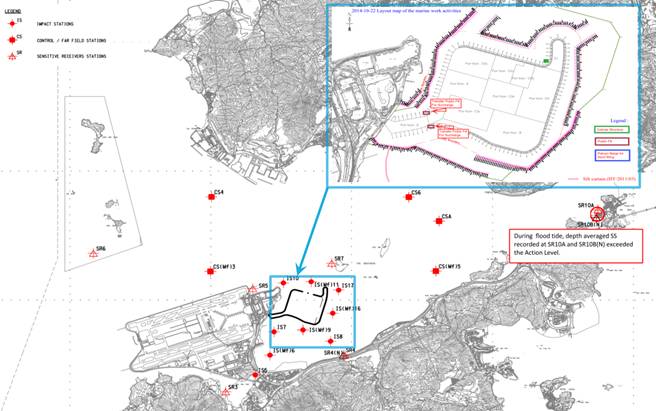
4.7.10.2
Exceedances were not due to marine based construction
works of the Project because:
4.7.10.3
IS(Mf)11 and IS10 are located downstream and closer to
the active works than monitoring station SR10B(N) and SR10A during flood tide
on 22 October 2014. Depth Averaged Suspended Solids (SS) values (in mg/L)
recorded during flood tide on the same day at IS(Mf)11 and IS10 were
below the Action and Limit Level which indicates project work is unlikely to
contribute to the action level exceedance recorded at SR10B(N) and SR10A.
4.7.10.4
The monitoring location of monitoring station SR10B(N)
and SR10A are considered upstream and remote to the active works of this
project during flood tide. Therefore it was unlikely that the exceedances
recorded at SR10B(N) and SR10A during flood tide were due to active
construction activities of this project on 22 October 2014.
4.7.10.5
The exceedances are likely due to local effects in the
vicinity of SR10B(N) and SR10A.
4.7.10.6
Action taken under the event and action plan:
1. Not applicable as SS was not measured in situ;
2. After considering the above mentioned investigation results, it appears that it was unlikely that the SS exceedances were attributed to active construction activities of this project;
3. IEC, contractor and ER were informed via email;
4. Monitoring data, all plant, equipment and Contractor's working methods were checked;
5-7. Since it is considered that the SS exceedances are unlikely to be project related, as such, actions 5 - 7 under the EAP are not considered applicable.
4.7.10.7
Nevertheless, the Contractor was reminded to ensure
provision of ongoing maintenance to the silt curtains and to carry out
maintenance work once defects were found.
4.7.10.8
As informed by the Contractor, maintenance work of the
silt curtain is on-going and carried out by the Contractor on a daily basis.
4.7.11 (2)
Two Action Level Exceedances of SS were recorded at IS10 and SR4(N) during
flood tide on 24 October 2014. Layout map below shows active works conducted on
24-Oct-14.
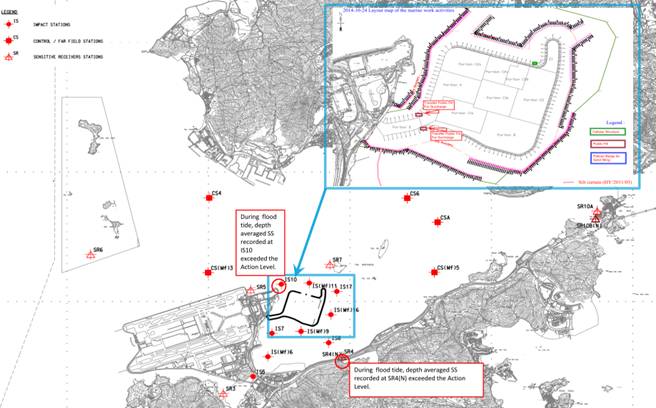
4.7.11.1
Exceedance recorded at IS10 during mid-flood tide is unlikely
due to marine based construction activities of the Project because:
4.7.11.2
With reference to the silt curtain checking record,
defects was observed at parts of the perimeter silt curtain which are close to
the IS10.
4.7.11.3
With reference to the information provided by the
Contractor, active construction works for cellular structure was carried out
northeast part of the perimeter silt curtain. Almost the same active
construction works was carried out on 22 and 27 October 2014 during the same
tide, impact water quality monitoring data recorded on 22 and 27 October 2014
IS10 are all below the Action and Limit Level which indicate exceedance
recorded at IS10 was unlikely due to active construction works for cellular
structure.
4.7.11.4
No filling activities was observed in progress and no
silt plume was observed to flow from the inside of the perimeter silt curtain
to the outside of the perimeter silt curtain when monitoring was conducted at
IS10.
4.7.11.5
Also, turbidity level recorded at SR5, IS10 and
IS(Mf)11 recorded on 24 October 2014 were below the action and limit level.
This indicates the turbidity level at area near IS10 was not adversely
affected.
4.7.11.6
The exceedance was likely due to local effects in the
vicinity of IS10.
4.7.11.7
Exceedance recorded at SR4(N) during flood tide IS
unlikely due to marine based construction activities of the Project because:
4.7.11.8
With reference to the silt curtain checking record
defects was not observed at southeast part of the perimeter silt curtain which
the closest to SR4(N).
4.7.11.9
The SS level recorded at IS(Mf)9, IS8 and IS(Mf)16
which located closer to active works were below the action and limit level
which indicates exceedance at SR4(N) were unlikely due to active construction
works for cellular structure .
4.7.11.10 Turbidity level recorded at SR4(N), IS(Mf)9, IS8 and IS(Mf)16 recorded
on 24 October 2014 were below the action and limit level. This indicates the
turbidity level at area near IS(Mf)11 was not adversely affected.
4.7.11.11 The exceedances were likely due to local effects in the vicinity of
SR4(N).
4.7.11.12 After investigation, there is no adequate information to conclude the
recorded exceedances are related to this Contract.
4.7.11.13 Action taken under the event and action plan:
1. Not applicable as SS was not measured in situ;
2. After considering the above mentioned investigation results, it appears that it was unlikely that the SS exceedances were attributed to active construction activities of this project;
3. IEC, contractor and ER were informed via email;
4. Monitoring data, all plant, equipment and Contractor's working methods were checked;
5-7. Since it is considered that the SS exceedances are unlikely to be project related, as such, actions 5 - 7 under the EAP are not considered applicable.
4.7.11.14 ET’s conclusions and recommendations for mitigation: Mitigation measures
such as perimeter silt curtain was implemented by the Contractor, however
defects of the perimeter silt curtain was observed, the Contractor was reminded
to ensure swift provision of maintenance to the silt curtains once defects were
found.
4.7.11.15 Contractor’s actions to implement the mitigation: With refer to the
maintenance record provided by the Contractor, maintenance work for the defects
of the northwest part of the perimeter silt curtain was conducted on 28 October
2014.
4.7.11.16
4.7.12 For
the action level exceedance of SS noted at IS8 during ebb tide on 31 October
2014. Layout map below shows active works conducted on 31-Oct-14 during ebb
tide.
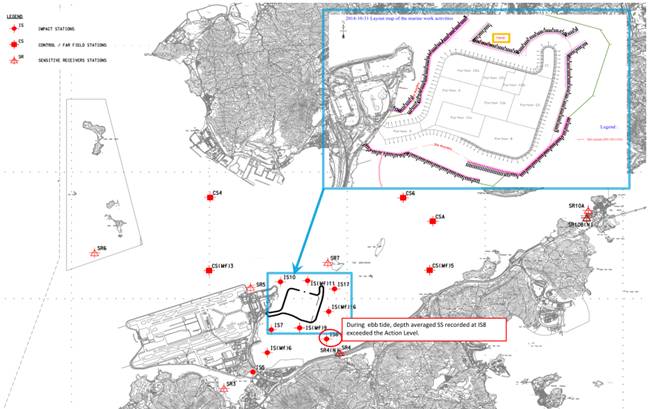
4.7.12.1
Exceedance recorded at IS8 during ebb tide is unlikely
due to marine based construction activities of the Project because:
4.7.12.2
With reference to the information provided by the
Contractor, no marine works was conducted during ebb tide, it is unlikely to
cause silt plume and contribute to the elevation of SS at IS8 during ebb tide.
4.7.12.3
IS(Mf)9 is located closer to the construction site
than monitoring station IS8. Depth Averaged Suspended Solids (SS) values (in mg/L)
recorded during the ebb tide on 31 October 2014 at IS(Mf)9 was below the Action
and Limit Level which shows that the water quality closer to construction site
was not adversely affected.
4.7.12.4
In accordance with the silt curtain integrity checking
record of 31 October 2014, no defect of the perimeter silt curtain was observed
at the southeast part of HKBCF Reclamation Works. In addition, with referred to
monitoring record , no sediment plume has been observed to flow from the inside
of the perimeter silt curtain to the outside of the perimeter silt curtain and
no discoloration of sea water has been observed at IS8.
4.7.12.5
Turbidity level recorded at IS8, IS(Mf)9 and IS(Mf)16
on 31 October were below the action and limit level. This indicates the
turbidity level at area near IS8 was not adversely affected
4.7.12.6
The exceedance was likely due to local effects in the
vicinity of IS8.
4.7.12.7
As such, the exceedance recorded at IS8 is unlikely to
be project related.
4.7.12.8
Action taken under the event and action plan:
1. Not applicable as SS was not measured in situ;
2. After considering the above mentioned investigation results, it appears that it was unlikely that the SS exceedances were attributed to active construction activities of this project;
3. IEC, contractor and ER were informed via email;
4. Monitoring data, all plant, equipment and Contractor's working methods were checked;
5-7. Since it is considered that the SS exceedance is unlikely to be project related, as such, actions 5 - 7 under the EAP are not considered applicable.
4.7.12.9
Nevertheless, the Contractor was reminded to ensure
provision of ongoing maintenance to the silt curtains and to carry out
maintenance work once defects were found.
4.7.12.10 As informed by the Contractor, maintenance work of the silt curtain is
on-going and carried out by the Contractor on a daily basis.
4.7.13
The event action plan is annexed in Appendix L.
5
Dolphin
monitoring
5.1 Monitoring Requirements
5.1.1 Vessel based surveys for the Chinese White Dolphin (CWD), Sousa
chinensis, are to be conducted by a dedicated team comprising a qualified
marine mammal ecologist and experienced marine mammal observers (MMOs). The
purpose of the surveys are to evaluate the impact of the HKCBF reclamation and,
if deemed detrimental, to take appropriate action as per the EM&A manual.
5.1.2
This ‘Impact Monitoring’ follows several months of ‘Baseline
Monitoring’ so similar survey methodologies have been adopted to facilitate
comparisons between datasets. Further, the data collected are compatible
with, and are available for, incorporation into the data set managed by the
Agriculture, Fisheries and Conservation Department (AFCD) as part of Hong
Kong’s long term Marine Mammal Monitoring Programme.
5.2 Monitoring Equipment
5.2.1
Table 5.1 summarises the equipment used for the impact
dolphin monitoring.
Table 5.1 Dolphin Monitoring Equipment
|
Equipment |
Model |
|
Commercially licensed motor vessel |
15m in length with a 4.5m viewing platform |
|
Global Positioning System (GPS) x2 |
Integrated into T7000 Garmin GPS Map 76C |
|
Computers (T7000 Tablet, Intel Atom) |
Windows 7/MSO 13 Logger |
|
Camera |
Nikon D7100 300m 2.8D fixed focus Nikon D90 80-400mm zoom lens |
|
Laser Rangefinder |
Range Finder Bushnell 1000m |
|
Marine Binocular x3 |
Nexus 7 x 50 marine binocular with compass and reticules Fujinon 7 x 50 marine binocular with compass and reticules |
5.3 Monitoring Frequency and Conditions
5.3.1
Dolphin monitoring is conducted twice per month in
each survey area.
5.3.2
Dolphin monitoring is conducted only when visibility
is good (e.g., over 1km) and the sea condition is at a Beaufort Sea State of 4
or better.
5.3.3
When thunder storm, black rain or typhoon warnings are
in force, all survey effort is stopped.
5.4 Monitoring Methodology and Location
5.4.1
The impact dolphin monitoring is vessel-based and
combines line-transect and photo-ID methodology. The survey follows
pre-set and fixed transect lines in the two areas defined by AFCD as:
5.4.2 Northeast Lantau survey area; and
5.4.3 Northwest Lantau survey area.
5.4.4
The co-ordinates for the transect lines and layout map
have been provided by AFCD and are shown in Table 5.2 and Figure 4.
Table 5.2 Impact Dolphin Monitoring Line Transect Co-ordinates (Provided by AFCD)
|
|
HK Grid System |
Long Lat in WGS84 |
||
|
ID |
X |
Y |
Long |
Lat |
|
1 |
804671 |
814577 |
113.870308 |
22.269741 |
|
1 |
804671 |
831404 |
113.869975 |
22.421696 |
|
2 |
805475 |
815457 |
113.878087 |
22.277704 |
|
2 |
805477 |
826654 |
113.877896 |
22.378814 |
|
3 |
806464 |
819435 |
113.887615 |
22.313643 |
|
3 |
806464 |
822911 |
113.887550 |
22.345030 |
|
4 |
807518 |
819771 |
113.897833 |
22.316697 |
|
4 |
807518 |
829230 |
113.897663 |
22.402113 |
|
5 |
808504 |
820220 |
113.907397 |
22.320761 |
|
5 |
808504 |
828602 |
113.907252 |
22.396462 |
|
6 |
809490 |
820466 |
113.916965 |
22.323003 |
|
6 |
809490 |
825352 |
113.916884 |
22.367128 |
|
7 |
810499 |
820690 |
113.926752 |
22.325043 |
|
7 |
810499 |
824613 |
113.926688 |
22.360464 |
|
8 |
811508 |
820847 |
113.936539 |
22.326475 |
|
8 |
811508 |
824254 |
113.936486 |
22.357241 |
|
9 |
812516 |
820892 |
113.946329 |
22.326894 |
|
9 |
812516 |
824254 |
113.946279 |
22.357255 |
|
10* |
813525 |
818270 |
113.956156 |
22.303225 |
|
10* |
813525 |
824657 |
113.956065 |
22.360912 |
|
11 |
814556 |
818449 |
113.966160 |
22.304858 |
|
11 |
814556 |
820992 |
113.966125 |
22.327820 |
|
12 |
815542 |
818807 |
113.975726 |
22.308109 |
|
12 |
815542 |
824882 |
113.975647 |
22.362962 |
|
13 |
816506 |
819480 |
113.985072 |
22.314192 |
|
13 |
816506 |
824859 |
113.985005 |
22.362771 |
|
14 |
817537 |
820220 |
113.995070 |
22.320883 |
|
14 |
817537 |
824613 |
113.995018 |
22.360556 |
|
15 |
818568 |
820735 |
114.005071 |
22.325550 |
|
15 |
818568 |
824433 |
114.005030 |
22.358947 |
|
16 |
819532 |
821420 |
114.014420 |
22.331747 |
|
16 |
819532 |
824209 |
114.014390 |
22.356933 |
|
17 |
820451 |
822125 |
114.023333 |
22.338117 |
|
17 |
820451 |
823671 |
114.023317 |
22.352084 |
|
18 |
821504 |
822371 |
114.033556 |
22.340353 |
|
18 |
821504 |
823761 |
114.033544 |
22.352903 |
|
19 |
822513 |
823268 |
114.043340 |
22.348458 |
|
19 |
822513 |
824321 |
114.043331 |
22.357971 |
|
20 |
823477 |
823402 |
114.052695 |
22.349680 |
|
20 |
823477 |
824613 |
114.052686 |
22.360610 |
|
21 |
805476 |
827081 |
113.877878 |
22.382668 |
|
21 |
805476 |
830562 |
113.877811 |
22.414103 |
|
22 |
806464 |
824033 |
113.887520 |
22.355164 |
|
22 |
806464 |
829598 |
113.887416 |
22.405423 |
|
23 |
814559 |
821739 |
113.966142 |
22.334574 |
|
23 |
814559 |
824768 |
113.966101 |
22.361920 |
*Remark: Due to the presence of deployed silt curtain
systems at the site boundaries of the Project, some of the transect lines shown
in Figure 5 could not be fully surveyed during the regular survey. Transect 10
is reduced from 6.4km to approximately 3.6km in length due to the HKBCF
construction site. Therefore the total transect length for both NEL and NWL
combined is reduced to approximately 111km.
5.5 Monitoring Procedures
5.5.1
The study area incorporates 23 transects which are to be
surveyed twice per month. Each survey day lasts approximately 9
hours.
5.5.2
The survey vessel departs from Tung Chung Development
Pier, Tsing Yi Public Pier or the nearest safe and convenient pier.
5.5.3
When the vessel reaches the start of a transect line,
“on effort” survey begins. Areas between transect lines and traveling to and
from the study area are defined as “off effort”.
5.5.4
The transect line is surveyed at a speed of 6-8 knots
(11-14 km/hr). For the sake of safety, the speed was sometimes a bit slower to
avoid collision with other vessels. During some periods, tide and current
flow in the survey areas exceeds 7 knots which can affect survey speed. There
are a minimum of four marine mammal observers (MMOs) present on each survey,
rotating through four positions, observers (2), data recorder (1) and ‘rest’
(1). Rotations occur every 30 minutes or at the end of dolphin
encounters. The data recorder records effort, weather and sightings data
directly onto the programme Logger and is not part of the observer team.
The observers search with naked eye and binoculars between 90° and 270° abeam
(bow being 0°).
5.5.5
When a group of dolphins is sighted, position, bearing
and distance data are recorded immediately onto the computer and, after a short
observation, an estimate made of group size. These parameters are linked
to the time-GPS-ships data which are automatically stored in the programme
Logger throughout the survey period. In this manner, information on
heading, position, speed, weather, effort and sightings are stored in a format
suitable for use with DISTANCE software for subsequent line transect analyses.
5.5.6
Once the vessel leaves the transect line, it is deemed
to be “off effort”. The dolphins are approached with the purpose of taking high
resolution pictures for proper photo-identification of individual CWD.
Attempts to photograph all dolphins in the group are made. Both the left
and right hand sides of the dorsal fin area of each dolphin in the group are
photographed, if possible. On finishing photographing, the vessel will
return to the transect line at the point of departure and “on effort” survey is
resumed.
5.5.7
Sightings which are made while on the transect line
are referred to as "on effort sightings", while not on the actual
transect line are referred to as an “opportunistic sightings” (e.g. another
group of dolphins is sighted while travelling back to the transect line).
Only “on effort sightings” can be used in analyses which require effort or rate
quantification, e.g., encounter rate per 100km searched. This is also how
“on effort sightings” are treated in the baseline report. “Opportunistic
sightings” provide additional information on individual habitat use and population
distribution and they are noted accordingly.
5.5.8
As time and GPS data are automatically logged
throughout the survey and are linked to sightings data input, start and end
times of encounters and deviation from the transect lines are recorded and can
be subsequently reviewed.
5.6 Monitoring Schedule for the
Reporting Month
5.6.1 The schedule for dolphin monitoring in October 2014 is provided in
Appendix F.
5.6.2 Two surveys covering both study areas were completed.
5.7 Results and Observations
5.7.1 Dolphin surveys were conducted on
13, 14, 20 and 21 October 2014. A total of 220.1 km of transect line was
conducted under favourable conditions. The total length travelled was
also 220.1 km, please note that that some lines were shortened due to works
and/or shipping traffic.
The
effort summary and sightings data are shown in Tables 5.3 and 5.4,
respectively. The survey efforts conducted in September 2014 are plotted in
Figure 5a-b. For Table 5.3, only on-effort information is included. Transects
conducted in all Beaufort Sea State are included. Compared to previous monthly
reports, the whole number Beaufort Sea State scale is used so as to ease
comparison with other dolphin monitoring reports.
Table 5.3 Impact Dolphin Monitoring Survey Effort Summary, Effort by Area and Beaufort Sea State
|
Survey |
Date |
Area |
Beaufort |
Effort (km) |
Total Distance Travelled (km) |
|
|
1 |
10/13/2014 |
NWL |
1 |
13.1 |
63 |
|
|
10/13/2014 |
NWL |
2 |
33.3 |
|||
|
10/13/2014 |
NWL |
3 |
16.6 |
|||
|
10/14/2014 |
NWL |
2 |
3.1 |
47.2 |
||
|
10/14/2014 |
NWL |
3 |
6.9 |
|||
|
10/14/2014 |
NEL |
1 |
32.9 |
|||
|
10/14/2014 |
NEL |
2 |
4.3 |
|||
|
2 |
10/20/2014 |
NWL |
1 |
14.7 |
62.7 |
|
|
10/20/2014 |
NWL |
2 |
47 |
|||
|
10/20/2014 |
NWL |
3 |
1 |
|||
|
10/21/2014 |
NWL |
1 |
9.9 |
47.2 |
||
|
10/21/2014 |
NEL |
1 |
37.3 |
|||
|
TOTAL in October 2014 |
220.1 |
|||||
*Remark: Surveys conduct under Beaufort Sea State 3 or below are considered as under favourable condition.
|
Location |
No. Sightings “on effort” |
No. Sightings “opportunistic” |
|
|
10/13/2014 |
NW L |
2 |
1 |
|
NEL |
0 |
0 |
|
|
10/14/2014 |
NW L |
0 |
0 |
|
NEL |
0 |
0 |
|
|
10/20/2014 |
NW L |
2 |
1 |
|
NEL |
0 |
0 |
|
|
10/21/2014 |
NW L |
0 |
0 |
|
NEL |
0 |
0 |
|
|
TOTAL in September 2014 |
4 |
2 |
|
Table 5.4 Impact Dolphin Monitoring Survey Details October 2014
Table 5.5 The Encounter Rate of Number of Dolphin Sightings & Total Number of Dolphins per Area^
|
Encounter Rate of Number of Dolphin Sightings (STG)* |
||||||
|
Date |
NEL Track (km) |
NWL Track (km) |
NEL Sightings |
NWL Sightings |
NEL Encounter Rate |
NWL Encounter Rate |
|
13 & 14/10/2014 |
37.2 |
73.0 |
0 |
2 |
0.0 |
2.7 |
|
20 & 21/10/2014 |
37.3 |
72.6 |
0 |
2 |
0.0 |
2.8 |
|
Encounter Rate of Total Number of Dolphins (ANI)** |
||||||
|
Date |
NEL Track (km) |
NWL Track (km) |
NEL Dolphins |
NWL Dolphins |
NEL Encounter Rate |
NWL Encounter Rate |
|
13 & 14/10/2014 |
37.2 |
73.0 |
0 |
10 |
0.0 |
13.7 |
|
20 & 21/10/2014 |
37.3 |
72.6 |
0 |
4 |
0.0 |
5.5 |
* Encounter Rate of Number of Dolphin Sightings (STG) presents encounter rates in terms of groups per 100km.
** Encounter Rate of Total Number of Dolphins (ANI) presents encounter rates in terms of individuals per 100km. And the encounter rate is not corrected for individuals, calculation may represent double counting.
^The table is made only for reference to the quarterly STG & ANI, which were adopted for the Event & Action Plan.
5.7.2
A total of six sightings were made, four
“on effort” and two “opportunistic”. Three sightings were made on the 13
October 2014 in NWL and three sightings were made on 20 October 2014 also in
NWL. A total of twenty-two individuals were sighted from the two impact
dolphin surveys in the reporting period. Sighting details are summarised and
plotted in Appendix K and Figure 5c, respectively.
5.7.3
Behaviour: Of the six sightings, two
groups were feeding, one group was travelling and three groups was engaged in
multiple activities, two of which comprised feeding and surface active
behaviours and one of which comprised feeding and travelling behaviours. The
locations of sighting with different behaviour are mapped in Figure 5d.
5.7.4 Two calves were recorded in October 2014. The mother of one was HZMB 026. The
location of sighting with calf is mapped in Figure 5e.
5.7.5 Photo ID analyses for September 2014 is presented in Appendix K.
5.7.6 No resightings were made during September 2014. One new adult was
identified and added to the catalogue (HZMB 124)
5.7.7 Noteworthy Observation[1]:
5.7.7.1
When impact monitoring was conducted at the southern
parts of transect lines 1 & 2, the view of the area was partially blocked
by the working vessels and fixed structures which do not belong to HKBCF
Reclamation Works. The number of fixed structures has increased and the
working vessels have moved when compared to last month’s observations. As the
working vessels will move during the on-going works, it is considered that they
will temporarily affect survey protocol, survey data collection, dolphin movement,
dolphin habitat use and dolphin behaviour, whereas the fixed structures will
continuously affect survey protocol, survey data collection, dolphin movement,
dolphin habitat use and dolphin behaviour.
5.7.7.2
The HKBCF Project effected line 12. The view of the
area was partially blocked by the working vessels and in water structures. As
the working vessels will move as construction progresses, they will cause
temporary effects to survey protocol, survey data collection, dolphin movement,
dolphin habitat use and dolphin behaviour, whereas the fixed structures will
affect all survey protocols and dolphin ecology in the long term.
5.7.7.3
The northern end of line 9 and 10 was affected by
works which do not belongs to the HKBCF Reclamation Works; in particular, the
view of the area was partially blocked by the working vessels. The number area
of the works site has increased in size and the working vessels have moved
position when compared to observations made during last month’s survey. As the
working vessels will move during the on-going works, they will temporarily
affect survey data collection, dolphin movement, dolphin habitat use and
dolphin behaviour. The works here are creating a reclamation/sea wall site
which is permanent and will thus continuously affect all survey protocols and
dolphin ecology.
5.7.7.4
Anchored vessels affected southern end of line 18 on
14 October 2014 and northern part of line 22 on 22 October 2014 and line 23 on
14 & 21 October 2014. Vessels have rarely been noted as anchoring
here some were only sighted on one survey day. It is therefore assumed that
only a limited impact was made on survey data collection, dolphin movement,
dolphin habitat use and dolphin behaviour on the days in question.
5.7.7.5
It was observed that lines 11 and 12 were affected by
other project marine works activities which were not related to the HKBCF
Reclamation Works.
5.7.7.6
Several new projects are ongoing at the southern ends
of lines 1-7 and 12. These works partially blocked some of the survey view. No
fixed structures were observed lines 1-7, however, line 12 works include fixed
structures. As it is not known what activities these barges and platforms are
conducting, the effect that these works may specifically have on dolphins is not
known at this time.
5.7.7.7
The survey effort log notes the areas in which the
visibility is limited or the survey is affected so that these can be accounted
for in any subsequent analyses. Some of these obstructions will
become permanent and some will be temporary as the HZMB is built
and other projects progress. It is advised that the impact monitoring surveys
should be completed as close to the predefined lines as possible (as per Figure
4 of this report).
5.7.7.8 The above noteworthy observations are largely a result of multiple and
on-going infrastructure projects within the Lantau area. No amendment to
EM&A protocols can negate the effects of these projects, e.g., it is a
highly dynamic environment and viewing conditions may alter every survey
(sometimes within surveys) and most of the survey area is affected, to some
degree, by marine construction works. Instead, survey data analyses
should incorporate any noteworthy observations which may affect either data
collection or dolphin distribution and behavioural changes. The above
mentioned activities recorded during boat survey will not affect implementation
of the EM&A Programme provided appropriate data analyses are conducted. Given that viewing conditions will change
frequently during the construction phase of HZMB, it is inappropriate at this
time to implement any changes in EM&A procedures, however, a review of
survey conditions will be made from time to time to assess if changes to
procedures are required.
5.7.8 The event action plan is annexed in Appendix L.
6.
ENVIRONMENTAL SITE
INSPECTION AND AUDIT
6.1 Site Inspection
6.1.1
Site Inspections were carried out on a weekly basis to
monitor the implementation of proper environmental pollution control and
mitigation measures for the Project. In the reporting month, 5 site inspections
were carried out on 3, 9, 16, 23 and 30 October 2014.
6.1.2
Particular observations during the site inspections
are described below:
Air Quality
6.1.3
Fugitive dust was observed generated when truck pass
through a road at Portion D. The Contractor is reminded to provide sufficient
dust control measures to prevent generation of fugitive dust. The Contractor
provided dust control measures to prevent generation of fugitive dust. (Closed)
6.1.4
Dust control measure was not observed at the ramp of
Portion D. The Contractor was reminded to provide dust control measure such to
ramp with exposed soil which the water car has no access. (Reminder)
Noise
6.1.5
No adverse observation was identified in the reporting
month.
Water Quality
6.1.6
Oil drum was observed without drip tray. The
Contractor was reminded to provide mitigation measures such as drip tray or
bunding to oil drum. The Contractor provided mitigation measures such as drip
tray to oil drum. (Closed)
6.1.7
Oil drum was observed without drip tray, the
Contractor was reminded to provide drip tray to oil drums. The Contractor
cleared the oil drum. (Closed)
6.1.8
It was observed that the frame of a drip tray was
deformed; the Contractor was reminded to provide drip tray without defects. The
Contractor provided drip tray without defects to oil drums. (Closed)
6.1.9
Public fill were observed on the edge of barge at
Portion D. The Contractor was reminded to clear it to prevent potential runoff
to the surrounding (Reminder)
6.1.10
Defects such as disconnection and insufficient
overlapping of the perimeter silt curtain have been observed. The Contractor
was advised to rectify the defects such as disconnection and insufficient
overlapping of the perimeter silt curtain as soon as possible. The Contractor
rectified the defects such as disconnection and insufficient overlapping of the
perimeter silt curtain. (Closed)
6.1.11
Silty water was observed at both side of the northern
part of the perimeter silt curtain. The Contractor was reminded to conduct
necessary checking of the integrity of the silt curtain and swiftly carry out
maintenance and repair once any defect is found. Photo record shows that the
situation was not observed on 10 Oct 2014. (Closed)
6.1.12
Oil and water mixture was observed accumulated inside
a drip tray. The Contractor was reminded to clear the mixture to prevent
runoff. The Contractor cleared the mixture. (Closed)
6.1.13
Powered Mechanical Equipment (PME) was observed
located close to sea. The Contractor was reminded to put the PME away from sea
to prevent potential runoff. (Reminder)
Chemical and Waste Management
6.1.14
Stack of cardboard paper and wave barriers were
observed when inspection was conducted at area between steel cell #91 – 94. The
Contractor was reminded to stored general refuse within a temporary refuse
collection facility, in appropriate containers prior to collection and
disposal. (Reminder)
6.1.15
General refuse was observed at portion D, the
Contractor was reminded to clear the general refuse regularly to keep the site
clean and tidy. The Contractor cleared the generate refuse. (Closed)
Landscape and Visual Impact
6.1.16
No relevant adverse impact was observed in the
reporting month.
Others
6.1.17
Rectifications of remaining identified items are
undergoing by the Contractor. Follow-up inspections on the status on provision
of mitigation measures will be conducted to ensure all identified items are
mitigated properly.
6.2 Advice on the Solid and Liquid Waste
Management Status
6.2.1 The Contractor had registered as a chemical waste producer for this
Project. Receptacles were available for general refuse collection and sorting.
6.2.2 As advised by the Contractor, 1,750,755.2m3 of fill were imported for
the Project use in the reporting period. 3kg of metal, 41kg of paper/cardboard
packaging, 1,200kg chemical waste and 65m3 of general refuse were generated and
disposed of in the reporting period. Monthly summary of waste flow table is
detailed in Appendix M.
6.2.3
The Contractor is advised to properly maintain on site
C&D materials and wastes storage, collection, sorting and recording system,
dispose of C&D materials and wastes at designated ground and maximize reuse
/ recycle of C&D materials and wastes. The Contractor is reminded to
properly maintain the site tidiness and dispose of the wastes accumulated on
site regularly and properly.
6.2.4
The Contractor is reminded that chemical waste should
be properly treated and stored temporarily in designated chemical waste storage
area on site in accordance with the Code of Practice on the Packaging, Labeling
and Storage of Chemical Wastes.
6.3 Environmental Licenses and Permits
6.3.1
The environmental licenses and permits for the Project
and valid in the reporting month is summarized in Table 6.1.
Table 6.1 Summary of Environmental Licensing and Permit Status
|
Statutory Reference |
License/ Permit |
License or Permit No. |
Valid Period |
License/ Permit Holder |
Remarks |
|
|
From |
To |
|||||
|
EIAO |
Environmental Permit |
EP-353/2009/G |
06/08/2012 |
N/A |
HyD |
Hong Kong – Zhuhai – Macao Bridge Hong Kong Boundary Crossing Facilities |
|
EP-354/2009/B |
28/01/2014 |
N/A |
Tuen Mun – Chek Lap Kok Link (TMCLKL Southern Landfall Reclamation only) |
|||
|
APCO |
NA notification |
-- |
30/12/2011 |
-- |
CHEC |
Works Area WA2 and WA3 |
|
APCO |
NA notification |
-- |
17/01/2012 |
-- |
CHEC |
Works Area WA4 |
|
WDO
|
Chemical Waste Producer Registration |
5213-951-C1186-21 |
30/3/2012 |
N/A |
CHEC |
Chemical waste produced in Contract HY/2010/02 |
|
WDO
|
Chemical Waste Producer Registration |
5213-974-C3750-01 |
31/10/2012 |
-- |
CHEC |
Registration as Chemical Waste Producer at To Kau Wan(WA4) |
|
WDO
|
Chemical Waste Producer Registration |
5213-839-C3750-02 |
13/09/2012 |
-- |
CHEC |
Registration as Chemical Waste Producer at TKO 137(FB) |
|
WDO |
Billing Account for Disposal of Construction Waste |
7014181 |
05/12/2011 |
N/A |
CHEC |
Waste disposal in Contract HY/2010/02 |
|
NCO |
Construction Noise Permit |
GW-RS0990-14 |
18/09/2014 |
24/12/2014 |
CHEC |
Reclamation Works in Contract HY/2010/02 |
|
NCO |
Construction Noise Permit |
GW-RE0656-14 |
30/06/2014 |
22/12/2014 |
CHEC |
Section of TKO Fill Bank under Contract HY/2010/02 |
6.4 Implementation Status of Environmental Mitigation Measures
6.4.1
In response to the site audit findings, the
Contractors carried out corrective actions.
6.4.2
A summary of the Implementation Schedule of
Environmental Mitigation Measures (EMIS) is presented in Appendix C. Most of
the necessary mitigation measures were implemented properly.
6.4.3
Training of marine travel route for marine vessels
operator was given to relevant staff and relevant records were kept properly.
6.4.4
Regarding the implementation of dolphin monitoring and
protection measures (i.e. implementation of Dolphin Watching Plan, Dolphin
Exclusion Zone and Silt Curtain integrity Check), regular checking were
conducted by the experienced MMOs within the works area to ensure no dolphin
was trapped by the enclosed silt curtain systems. Any dolphin spotted within
the enclosed silt curtain systems was reported and recorded. Relevant
procedures were followed and measures were well implemented. Silt curtain
systems were also inspected timely in accordance to the submitted plan. All
inspection records were kept properly.
6.4.5
Acoustic decoupling measures on noisy plants on
construction vessels were checked regularly and the Contractor was reminded to
ensure provision of ongoing maintenance to noisy plants and to carry out
improvement work once insufficient acoustic decoupling measures were found.
6.4.6
Frequency of watering per day on exposed soil was
checked; with reference to the record provided by the Contract, watering was
conducted at least 8 times per day on reclaimed land. The frequency of watering
is the mainly refer to water truck. Sprinklers are only served to strengthen
dust control measure for busy traffic at the entrance of Portion D. As informed
by the Contractor, during the mal-function period of sprinkler, water truck will
enhance watering at such area. The Contractor was reminded to ensure provision
of watering of at least 8 times per day on all exposed soil within the Project
site and associated works areas throughout the construction phase.
6.4.7
EPD conducted inspection at HKBCF Reclamation Works at
11:36am on 23 October 2014, silt plume was observed spreading out from the
Portion E1 of the construction site through the silt curtain when filling
activities by derrick barge (振明28) was undergoing.
6.4.7.1
EPD subsequently issued a yellow form and requested
Contractor to report them via ET Leader and IEC within 7 days after issuing the
yellow form for the remedial actions and preventive actions taken to improve
the situation.
6.4.7.2
Insufficient Mitigation Measures: Silt plume was found
spreading out from Portion E1 of the construction site through the silt curtain
on 23 October 2014.
6.4.7.3
Review of Contractor’s investigation report and
rectifications.
6.4.7.4
Investigation actions:
· Review of monitoring data obtained 20, 22, 24 and 27 October 2014.
· Investigation report provided by the Contractor on 29 October 2014 was reviewed:
· Diver checking and rectification record for integrity of silt curtain has been checked.
· Inspection condition of sea area near Portion E1 on 31 October 2014 around 1pm.
6.4.7.5
Investigation results:
· Suspended Solids (SS) level and turbidity level recorded at IS(Mf)11, IS17 and IS(Mf)16 and IS8 on 20, 22, 24 and 27 October 2014 were reviewed. (for IWQM data, refer to Appendix J)
· Review of Suspended Solids (SS) level and turbidity level recorded at IS(Mf)11, IS17 and IS(Mf)16 and IS8 on 20 October 2014:
· Limit Level Exceedance of SS at IS8 during flood tide and Action Level Exceedance of IS17 during ebb tide was noted on 20 October 2014. After investigation, the exceedance recorded at IS8 are unlikely to be project related. However, exceedance recorded at IS17 is likely due to marine based construction activities of the Project. For details of investigation, please refer to investigation details section 4.7.3 to 4.7.4.
· Review of Suspended Solids (SS) level and turbidity level recorded at IS(Mf)11, IS17, IS(Mf)16 and IS8 on 22, 24 and 27 October 2014:
· Turbidity level and Suspended Solids recorded on 22, 24 and 27 October 2014 at IS(Mf)11, IS17, IS(Mf)16 and IS8 were below the action and limit level. This indicates the turbidity level and suspended solid at sea area close to portion E1 was not adversely affected on 22, 24 and 27 October 2014.
· Figure 3.2 of the investigation report showed that the silt plume was no longer observed at 02:09pm on 23 October 2014 after derrick barge (振明28) ceased the work at 11:40am.
· The Contractor arranged diver to check the integrity of the concerned silt curtain. Minor damaged found on the concerned silt curtain and rectification works had been carried out by the Contractor.
· Diver checking and rectification record for integrity of silt curtain has been checked and it shows that the part of the silt curtain which was suspected to be malfunction (showed by red arrow in the diagram below) has been rectified by the Contractor.
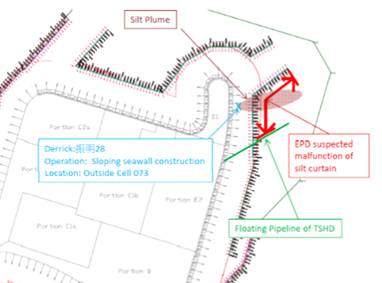
· Subsequently, a rock placement trial was conducted by the Contractor on 28 October 2014. Silt plume was observed during the process but Figure 3.8 of the investigation report shows that spreading to the outside of the silt curtain was prevented by the silt curtain.
· Photo records taken on 31 October 2014 shows the sea condition at sea area near the northeast side of the HKBCF Reclamation Works and no silt plume was observed spreading out from Portion E1 of the construction site through the silt curtain:
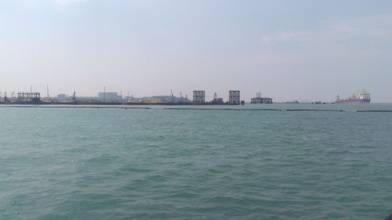
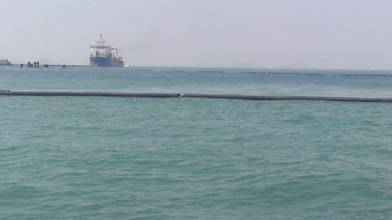
6.4.7.6
As informed by the Contractor, rockfill materials
would be placed more slowly by the derrick as well as the lowest dropping point
to minimize the generation of silt plume. Daily site inspection in the area
would be conducted so that any damaged parts of silt curtain can be observed
and repaired promptly.
6.4.7.7
The Contractor was further reminded to ensure swift
provision of maintenance to the perimeter silt curtains once defects of the
perimeter silt curtain were observed and continue the preventive measures during
rock filling and keep the site inspected at least daily to ensure compliance
with respect to the recommendations in the EIA Report and EM&A Manual in
particular on EIA Ref. Section 9.11.1.1
6.4.7.8
IWQM results on 29 and 31 October 2014 were review, no
exceedance was recorded at IS17, IS(Mf)11 and IS(Mf)16 which indicates that no
adverse water quality impact after the implementation of the preventive
measures.
6.4.7.9
To prevent recurrence of the observed incident, inspection
has been conducted by the Contractor on a daily basis to review if there is an
impact to the water quality caused by rock filling activities using derrick
barge and to promptly provide maintenance once any damaged parts of silt
curtain is observed. The Contractor was further reminded to carry out swift
rectification works to the situation once any adverse impact to the water
quality is observed.
6.4.7.10
The Contractor was reminded that all water quality
mitigation measures with respect to the recommendations in the EIA Report and
EM&A Manual in particular on EIA Ref. Section 9.11.1.1 should be fully and
properly implemented.
6.4.8
Review of Contractor's work and mitigation measures
with respect to the recommendations in the EIA Ref. Section 9.11.1.6:
6.4.8.1
Actions
taken:
· Review of monitoring results on 27 and 29 October 2014.
· Ad hoc site inspection was conducted on 31 October 2014
6.4.8.2
Investigation
results:
· IWQM data obtained on 27 and 29 October 2014 were reviewed; no water quality monitoring exceedance was noted on 27 and 29 October 2014.
· Ad hoc site inspection was subsequently conducted on 31 October 2014 but no silt plume or turbid water was observed on 31 October 2014. Photo records taking on 31 October 2014 at around 01:00pm which shows the sea condition at sea area near Portion E1 of the HKBCF Reclamation Works:
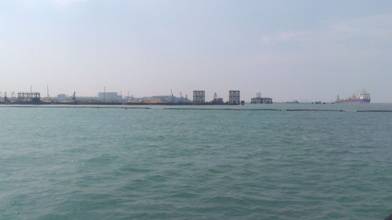
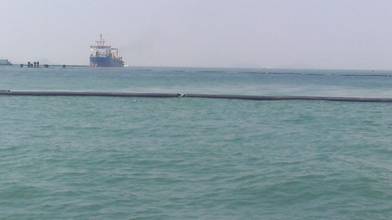
6.4.8.3
The water quality will be closely
monitored through IWQM works of this Contract, should any water quality
exceedance is recorded, investigation will be conducted following the EAP for
IWQM. Furthermore, joint site inspection will be conducted regularly to check
whether the water quality at monitoring stations of HKBCF reclamation works is
adversely affected.
6.4.8.4
The Contractor was reminded that all water
quality mitigation measures with respect to the recommendations in the EIA
Report and EM&A Manual in particular on EIA Ref. Section 9.11.1.6 should be
fully and properly implemented.
6.5 Summary of Exceedances of the Environmental Quality Performance Limit
6.5.1
One (1) 24-hour TSP result at AMS3B
exceeded Action Level on 27 October 2014, after investigation, the exceedance
was considered not related to this Contract. All 1-Hour TSP results were below
the Action and Limit Level in the reporting month.
6.5.2
For construction noise, no exceedance was
recorded at all monitoring stations in the reporting period.
6.5.3
A total of (18) eighteen exceedances were
recorded in this reporting month: (1) One Limit Level Exceedance of Turbidity
and (1) Limit Level Exceedance of Suspended Solids were recorded at IS17 during
ebb tide on 10 October 2014; (1) One Action Level Exceedance of SS at SR10B(N)
was recorded on10 October 2014 during flood tide; (1) One Action Level
Exceedance of SS at IS8 was recorded on 3 October 2014 during flood tide; (1)
One Action Level Exceedance of SS at IS(Mf)11 was recorded on 6 October 2014
during ebb tide; (2) Two Action Level Exceedances of SS at IS(Mf)11 and SR5
were recorded on 6 October 2014 during flood tide; (3) Three Action Level
Exceedances of SS were recorded at IS10, SR4(N) and SR5 on 13 October 2014
during flood tide; (1) One Action Level Exceedance of SS was recorded at IS17
on 20 October 2014 during ebb tide; (1) action level exceedance and (1) limit
level exceedance of SS were recorded at SR4(N) and IS8 respectively on 20
October 2014 during flood tide; (2) Two Action Level Exceedances of SS were
recorded at SR10A and SR10B(N) on 22 October 2014 during flood tide; (2) Two
Action Level Exceedances of SS were recorded at IS10 and SR4(N) during flood
tide on 24 October 2014. (1) One Action Level Exceedance was recorded at IS8 on
31 October 2014 during ebb tide.
6.5.4
After investigation, all impact water
quality exceedances were considered not related to this Contract except the Limit
Level Exceedance of Turbidity, Limit Level Exceedance of Suspended Solids
recorded at IS17 during ebb tide on 10 October 2014 and Action Level Exceedance
of Suspended Solids recorded at IS17 during flood tide on 20 October 2014,
which were considered related to this Contract. Recommendation has been given
and rectification has been carried on by the Contractor on 28 October 2014.
6.5.5
Cumulative statistics on exceedance is provided in
Appendix N.
6.6 Summary of Complaints, Notification of Summons and Successful
Prosecutions
6.6.1
The Environmental Complaint Handling Procedure is
annexed in Figure 6.
6.6.2
Two environmental complaints have been received in
October 2014.
6.6.3
As informed by the Contractor on 14 October 2014, a
follow up air quality complaint has been received by this Contract (same case
to environmental complaint EC-026). The complainant complained that about 20-30
sand barges always moor at the sea area opposite to tower 4 of Melody Garden
and Richland Garden. This problem has affected the air quality.
6.6.3.1
Investigation Actions:
· 1hr TSP and 24hrs TSP monitoring data of complaint period 1- 15 October 2014 have been reviewed.
· Site inspections were conducted jointly with RSS, IEC and the Contractor on 16 October 2014 and jointly with RSS and the Contractor on 23 October 2014.
6.6.3.2
Investigation findings:
· There is no sufficient information provided by the complainant to make sure that the concerned barges are related to this project.
· Date of the observed impact was not specified by the complainant so the impact air quality monitoring (IAQM) results within the complaint period 1- 15 October 2014 for monitoring stations close to the concerned area – AQMS1, ASR1, ASR5, ASR6 and ASR10 have been reviewed and there was one action level exceedance of 24hr TSP on impact air quality monitoring result recorded at ASR1 but no information which shows that the action level exceedance at ASR1 is related to vessel of this Contract. IAQM data AQMS1, ASR1, ASR5, ASR6 and ASR10 also available online from: http://www.hzmbenpo.com/php/list_air_year_All.php)
· As informed by the Contractor, the Contractor would continue to provide watering to stockpile of sand on sand delivery barges.
· Photo record below shows that sand barges were not covered but they are equipped with watering equipment and in order to prevent generation of fugitive dust, watering equipment was used to keep the sand filling material wet.
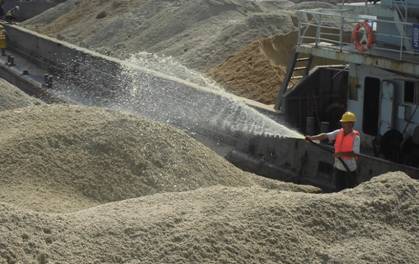
· In addition, site inspections were conducted jointly with RSS, IEC and the Contractor on 16 October 2014 and jointly with RSS and the Contractor on 23 October 2014, but no generation of fugitive dust was observed to be caused by barges loaded with filling material.
· Sand barges usually moor at around Sham Shui Kok anchorage area and the Contractor would continue to provide watering to stockpile of sand on sand delivery barges, therefore the potential impact to resident areas concerned by the complainant is low.
· The Contractor usually moor vessel at around Sham Shui Kok anchorage area (Except upon request by HK government and under this circumstances, then they will moor at Tuen Mun waters shortly for inspection.)
6.6.3.3
After investigation, there is no adequate information
to conclude the observed impact is related to this Contract.
6.6.3.4
The Contractor was advised to ensure to continue the
provision of fugitive dust mitigation measures to barges loaded with filling
material such as watering to sand filling material on sand barges to keep the
surface of stockpile of filling material wet.
6.6.4
With reference to RSS’s letter ref.:
211036/(HY2010/02)/M05/432/B07605 dated on 30 September 2014 pertaining the
performance on barges operations at the sea area off the Tuen Mun Ferry Pier. A
complaint concerning leakage of sand filling material from vessels at sea area
off Tuen Mun Ferry Pier was first received by EPD from Tuen Mun District
Council (TM DC) on 19 September 2014 and it was subsequently referred by EPD to
the Highways Department to handle on 23 September 2014 through EPD’s memo ref.:
EP/RW/0000362128. Referring to EPD's Memo, it is also noted that some local
residents at Tuen Mun expressed their concern that the stockpile of dusty sand
material on the barges should be covered with impervious sheeting to avoid
causing fugitive dust emissions of sand and dust. Subsequently, TM DC
followed up their complaint with Highways Department on 17 October 2014. The
follow up complaint concerning water quality impact at sea area off Tuen Mun
area was referred to the project team to response on 17 October 2014.
6.6.4.1
Investigation actions:
· Spot check of travel route record of sand delivery barges and review whether sand delivery barges of this Contract would moor/stay at sea area near Tuen Mun Ferry Pier
· Impact water quality monitoring (IWQM) results recorded in September and October 2014 which cover IWQM station(s) - IS14, IS15 and SR9 which are near to the concern area(s), have been reviewed.
· Regular site inspections were conducted jointly with RSS, IEC and the Contractor on 16 October 2014 and jointly with RSS and the Contractor on 23 October 2014.
6.6.4.2
Investigation findings:
· Spot check of travel route record also shows that that sand delivering vessels follow a designated marine travel route. However, only in particular cases, those vessels will moor near sea area off Butterfly beach for government department to carry out inspection. In general, the sand delivery barges were requested by the Contractor to moor as far away from residence as possible and continue to provide watering to stockpile of sand on sand delivery barges.
· Impact water quality monitoring (IWQM) results recorded in September and October 2014 which cover IWQM station(s) - IS14, IS15 and SR9 which are near to the concern area(s), have been reviewed. However no IWQM exceedance was noted in September and October 2014 at monitoring station IS14, IS15 and SR9 which are near to the concern area(s). (IWQM data of IS14, IS15 and SR9 available online at: http://www.hzmbenpo.com/php/list_water_year.php )
· In addition, site inspections were conducted jointly with RSS, IEC and the Contractor on 16 October 2014 and jointly with RSS and the Contractor on 23 October 2014, but no leakage of sand material or generation of fugitive dust was observed to be caused by barges loaded with sand material.
· In addition, sand delivery barges are equipped with watering equipment and in order to prevent generation of fugitive dust, watering equipment was used to keep the sand filling material wet.
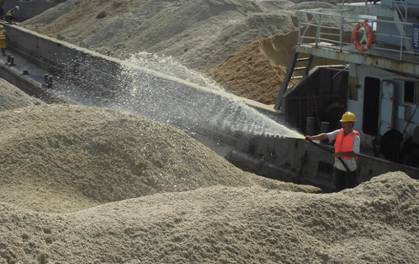
· Nonetheless, as informed by the Contractor, the Contractor would study the feasibility of covering stockpile of sand on sand delivery barges.
6.6.4.3
After investigation, there is no adequate information
to conclude the observed impact is related to this Contract. However, as
informed by the Contractor, the Contractor would study the feasibility of
covering stockpile of sand on sand delivery barges.
6.6.4.4
Nonetheless, the Contractor was advised to ensure that
all vessels should have regular maintenance to ensure that all Sand Barge
functioning well so that any leakage of filling material is prevented.
6.6.4.5
The Contractor was reminded, when vessel was not
requested by government department for inspection at sea area off Tuen Mun
Ferry Pier, the Contractor should avoid mooring their vessels at the concerned
area as far as possible.
6.6.4.6
The Contractor was advised to ensure to continue the
provision of fugitive dust mitigation measures to barges loaded with filling
material such as watering to sand filling material on sand barges to keep the
surface of stockpile of filling material wet.
6.6.4.7
In response to the concern raised on both air quality
and water quality, effectiveness of relevant mitigation measures would be
monitored through regular EM&A monitoring and site inspection of this
project.
6.6.5
No notification of summons and successful prosecutions
was received in the reporting period.
6.6.6
Statistics on complaints, notifications of
summons and successful prosecutions are summarized in Appendix N.
7. FUTURE KEY ISSUES
7.1 Construction Programme for the
Coming Months
7.1.1 As informed by the Contractor, the major works for the Project in
November 2014 and December 2014 will be*:-
Marine-base
- Cellular structure installation
- Capping Beams structures
- Optimizing rubble mound seawalls
- Conforming sloping seawalls
- Laying geo-textile
- Rock filling
- Sand filling
- Public filling
- Band drain installation
- Surcharge laying
- Geotechnical Instrumentation works
- Precast Yard for seawall blocks & culverts
- Maintenance of silt curtain & silt screen at sea water intake of HKIA
Land-base
- Maintenance works of Site Office at Works Area WA2
- Maintenance works of Public Works Regional Laboratory at Works Area WA3
- Maintenance of Temporary Marine Access at Works Area WA2
*Construction activities in November & December 2014 will be changed subject to works progress.
7.2 Key Issues for the Coming Month
7.2.1
Key issues to be considered in the coming months:-
- Site runoff should be properly collected and treated prior to discharge;
- Minimize loss of sediment from filling works;
- Regular review and maintenance of silt curtain systems, drainage systems and desilting facilities;
- Exposed surfaces/soil stockpiles should be properly treated to avoid generation of silty surface run-off during rainstorm;
- Regular review and maintenance of wheel washing facilities provided at all site entrances/exits;
- Conduct regular inspection of various working machineries and vessels within works areas to avoid any dark smoke emission;
- Suppress dust generated from work processes with use of bagged cements, earth movements, excavation activities, exposed surfaces/soil stockpiles and haul road traffic;
- Quieter powered mechanical equipment should be used;
- Provision of proper and effective noise control measures for operating equipment and machinery on-site, such as erection of movable noise barriers or enclosure for noisy plants;
- Closely check and replace the sound insulation materials regularly;
- Better scheduling of construction works to minimize noise nuisance;
- Properly store and label oil drums and chemical containers placed on site;
- Proper chemicals, chemical wastes and wastes management;
- Maintenance works should be carried out within roofed, paved and confined areas;
- Collection and segregation of construction waste and general refuse on land and in the sea should be carried out properly and regularly; and
- Proper protection and regular inspection of existing trees, transplanted/retained trees.
- Control night-time lighting and glare by hooding all lights.
- Regular review and provide maintenance to dust control measures such as sprinkler system.
7.3 Monitoring Schedule for the Coming
Month
7.3.1
The tentative schedule for environmental monitoring in
November 2014 is provided in Appendix F.
8. ConclusionS AND RECOMMENDATIONS
8.1 Conclusions
8.1.1
The construction phase and EM&A programme of the
Project commenced on 12 March 2012.
8.1.2
One (1) 24-hour TSP result at AMS3B exceeded Action
Level on 27 October 2014, after investigation, the exceedance was considered
not related to this Contract. All 1-Hour TSP results were below the Action and
Limit Level in the reporting month.
8.1.3
For construction noise, no exceedance was recorded at
all monitoring stations in the reporting period.
8.1.4
A
total of (18) eighteen exceedances were recorded in this reporting month: (1)
One Limit Level Exceedance of Turbidity and (1) Limit Level Exceedance of
Suspended Solids were recorded at IS17 during ebb tide on 10 October 2014; (1)
One Action Level Exceedance of SS at SR10B(N) was recorded on10 October 2014
during flood tide; (1) One Action Level Exceedance of SS at IS8 was recorded on
3 October 2014 during flood tide; (1) One Action Level Exceedance of SS at
IS(Mf)11 was recorded on 6 October 2014 during ebb tide; (2) Two Action Level
Exceedances of SS at IS(Mf)11 and SR5 were recorded on 6 October 2014 during
flood tide; (3) Three Action Level Exceedances of SS were recorded at IS10,
SR4(N) and SR5 on 13 October 2014 during flood tide; (1) One Action Level
Exceedance of SS was recorded at IS17 on 20 October 2014 during ebb tide; (1)
action level exceedance and (1) limit level exceedance of SS were recorded at
SR4(N) and IS8 respectively on 20 October 2014 during flood tide; (2) Two
Action Level Exceedances of SS were recorded at SR10A and SR10B(N) on 22
October 2014 during flood tide; (2) Two Action Level Exceedances of SS were
recorded at IS10 and SR4(N) during flood tide on 24 October 2014. (1) action
level exceedance was recorded at IS8 on 31 October 2014 during ebb tide.
8.1.5
After investigation, all impact water quality
exceedances were considered not related to this Contract except the Limit Level
Exceedance of Turbidity, Limit Level Exceedance of Suspended Solids recorded at
IS17 during ebb tide on 10 October 2014 and Action Level Exceedance of
Suspended Solids recorded at IS17 during flood tide on 20 October 2014, which
were considered related to this Contract. Recommendation has been given and
rectification has been carried on by the Contractor on 28 October 2014.
8.1.6
A total of six sightings were made, four “on effort”
and two “opportunistic”. Three sightings were made on the 13 October 2014
in NWL and three sightings were made on 20 October 2014 also in NWL. A
total of twenty-two individuals were sighted from the two impact dolphin
surveys in the reporting period. Sighting details are summarised and plotted in
Appendix K and Figure 5c, respectively.
8.1.7
Behaviour: Of the six sightings, two groups were
feeding, one group was travelling and three groups was engaged in multiple
activities, two of which comprised feeding and surface active behaviours and
one of which comprised feeding and travelling behaviours. The locations of
sighting with different behaviour are mapped in Figure 5d.
8.1.8
Two calves were recorded in October 2014. The mother of one was HZMB 026. The location of sighting
with calf is mapped in Figure 5e.
8.1.9
Environmental site inspection was carried out 5 times
in October 2014. Recommendations on remedial actions were given to the
Contractors for the deficiencies identified during the site audits.
8.1.10
Two environmental complaints have been received in
October 2014. After investigation, there is no adequate information to conclude
the observed impacts are related to this Contract.
8.1.11
No notification summons and successful prosecution was
received in the reporting period.
8.2 Recommendations
8.2.1
According to the environmental site inspections
performed in the reporting month, the following recommendations were provided:
Air Quality Impact
l All working plants and vessels on site should be regularly inspected and properly maintained to avoid dark smoke emission.
l All vehicles should be washed to remove any dusty materials before leaving the site.
l Haul roads should be sufficiently dampened to minimize fugitive dust generation.
l Wheel washing facilities should be properly maintained and reviewed to ensure properly functioning.
l Temporary exposed slopes and open stockpiles should be properly covered.
l Enclosure should be erected for cement debagging, batching and mixing operations.
l Water spraying should be provided to suppress fugitive dust for any dusty construction activity.
l Regular review and provide maintenance to dust control measures such as sprinkler system.
Construction Noise Impact
l Quieter powered mechanical equipment should be used as far as possible.
l Noisy operations should be oriented to a direction away from sensitive receivers as far as possible.
l Proper and effective noise control measures for operating equipment and machinery on-site should be provided, such as erection of movable noise barriers, enclosure for noisy plants or enhancement works to provide sufficient acoustic decoupling measure(s). Closely check and replace the sound insulation materials regularly
l Vessels and equipment operating should be checked regularly and properly maintained.
l Noise Emission Label (NEL) shall be affixed to the air compressor and hand-held breaker operating within works area.
l Acoustic decoupling measures should be properly implemented for all existing and incoming construction vessels with continuous and regularly checking to ensure effective implementation of acoustic decoupling measures.
Water Quality Impact
l Regular review and maintenance of silt curtain systems, drainage systems and desilting facilities in order to make sure they are functioning effectively.
l Construction of seawall should be completed as early as possible.
l Regular inspect and review the loading process from barges to avoid splashing of material.
l Silt, debris and leaves accumulated at public drains, wheel washing bays and perimeter u-channels and desilting facilities should be cleaned up regularly.
l Silty effluent should be treated/ desilted before discharged. Untreated effluent should be prevented from entering public drain channel.
l Proper drainage channels/bunds should be provided at the site boundaries to collect/intercept the surface run-off from works areas.
l Exposed slopes and stockpiles should be covered up properly during rainstorm.
Chemical and Waste Management
l All types of wastes, both on land and floating in the sea, should be collected and sorted properly and disposed of timely and properly. They should be properly stored in designated areas within works areas temporarily.
l All chemical containers, batteries and oil drums should be properly stored and labelled.
l All plants and vehicles on site should be properly maintained to prevent oil leakage. Proper measures, like drip trays and/or bundings, should be provided for retaining leaked oil/chemical from plants.
l All kinds of maintenance works should be carried out within roofed, paved and confined areas.
l All drain holes of the drip trays utilized within works areas should be properly plugged to avoid any oil and chemical waste leakage.
l Oil stains on soil surface, accumulated oil mixture and empty chemical containers should be cleared and disposed of as chemical waste.
l Regular review should be conducted for working barges and patrol boats to ensure sufficient measures and spill control kits were provided on working barges and patrol boats to avoid any spreading of leaked oil/chemicals.
Landscape and Visual Impact
l All existing, retained/transplanted trees at the works areas should be properly fenced off and regularly inspected.
l Control night-time lighting and glare by hooding all lights.
[1] A noteworthy observation is to show that either the conduct of the surveys themselves is affected, i.e., the noted vessel or works impedes the progress or view of the survey platform. In addition, the vessel or construction works may be different or additional to that observed previously and further, are of such a nature that they are a likely to create an impact on the movement or behaviour of the subject of the impact survey, in this case, the dolphins.